
Blog
Why the Effective Date of a Tractor Appraisal Can Decide Your Divorce Case
The effective date of a tractor appraisal, not the inspection date, determines which day's market sets its value in a divorce case. This guide explains why that date shifts by state and how the wrong one can sink your valuation in court.
A tractor appraisal is only as useful as the date it answers for. In a divorce, the court doesn't want to know what a tractor is worth today; it wants to know what it was worth on a specific, legally meaningful date, and that date is rarely the day the appraiser walks the field. Understanding the effective date, and how it differs from the inspection date and the report date, is the difference between a valuation the court can use and one that gets challenged out of the case.
We prepare tractor appraisals for divorce regularly, and the single most common mistake we see from parties who come to us after a first appraisal has already been rejected isn't bad math. It's the wrong date.
What Is the Effective Date of an Appraisal?
The effective date is the date to which the appraiser's opinion of value applies. It is a core concept in appraisal practice, distinct from the date the appraiser physically examined the tractor and distinct from the date the written report was finalized and signed.
Those three dates can line up, but they often don't. A tractor might be inspected in March 2026, with a report issued in April 2026, but valued as of a separation date back in August 2025. In that case, the appraiser has to determine what the tractor was worth nearly eight months before the inspection ever happened, using the market and condition evidence that existed as of that earlier date.
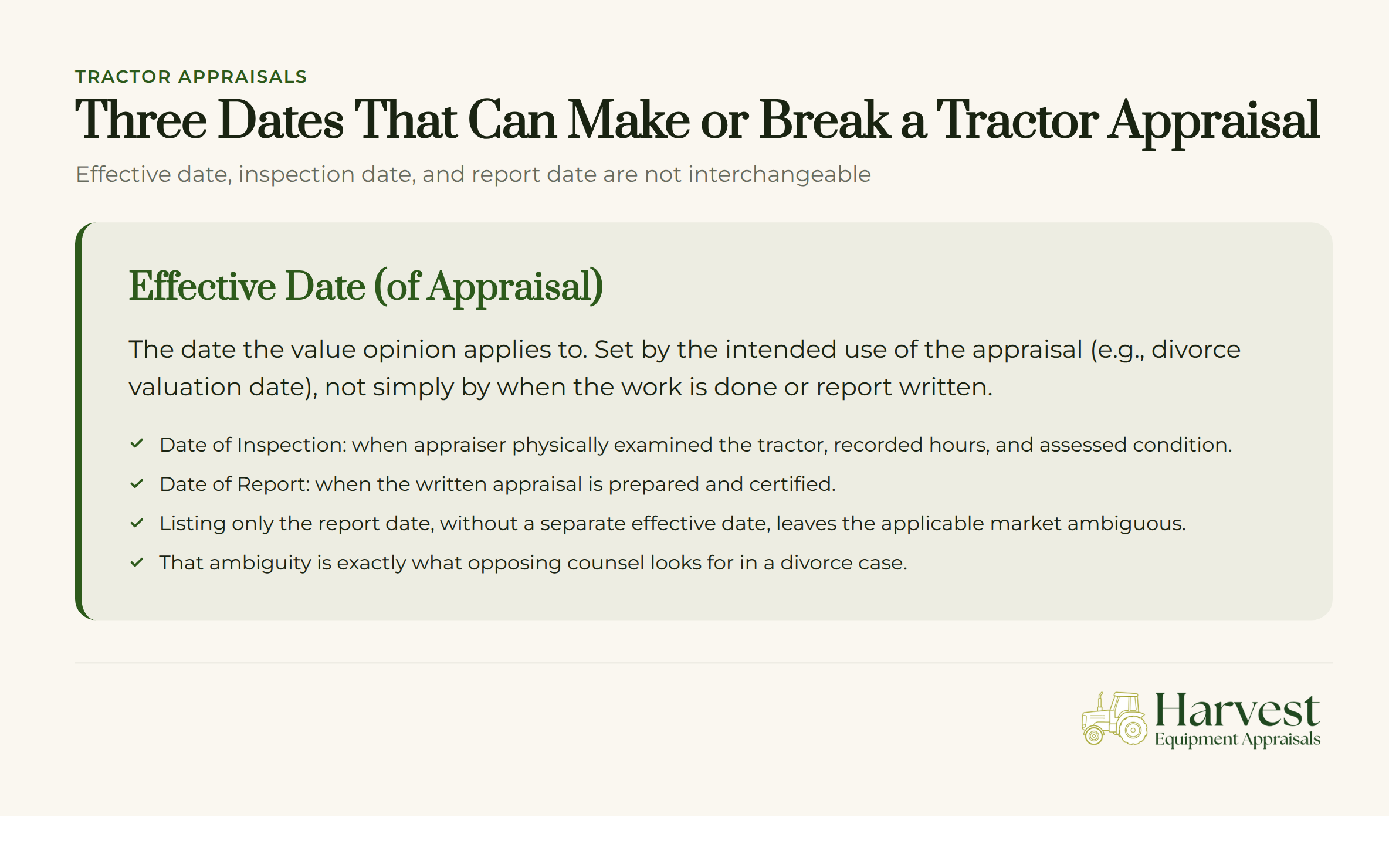
Effective Date vs. Inspection Date vs. Report Date
- Effective date: The date the value opinion applies to. This is set by the intended use of the appraisal, not by the appraiser's calendar.
- Date of inspection: The date or dates the appraiser physically examined the tractor, recorded hours, and assessed condition.
- Date of report: The date the written appraisal is prepared and certified.
A report that only states the date it was written, without separately identifying the effective date, leaves the reader guessing which market the value actually reflects. That ambiguity is exactly what opposing counsel looks for.
A Clearer Example First: How Estate Appraisals Set the Date
Before getting into divorce, it helps to see how this works when the rule is simple. For an estate, the effective date is almost always the date of death, because that is the date federal estate tax law uses to value the decedent's property. The only alternative is a formal alternate valuation date, available in limited circumstances, six months after death. The IRS sets that alternate-date option under specific conditions tied to estate tax filings; see IRS.gov for current guidance on when it applies.
That's a fixed, federally defined rule. Everyone involved in an estate case knows exactly which day matters. Divorce doesn't work that way, and that's where most of the confusion starts.
Why Divorce Valuation Dates Are Different in Every State
There is no single nationwide rule for which date governs marital property valuation in a divorce. Depending on the state, the court, or an agreement between the parties, the controlling date could be any of the following:
- The date of separation
- The date the divorce petition was filed
- The date of trial or the final evidentiary hearing
- The date the divorce becomes final
- A date the parties stipulate to directly
Some states lean toward valuing assets closer to trial, on the theory that the court should divide property based on its most current, accurate value. Others look to the date of separation or filing, on the theory that one spouse shouldn't benefit or suffer from what happens to an asset's value after the marriage has effectively ended. Courts in some jurisdictions have gone further and used different valuation dates for different assets in the same case, treating a farm or piece of farm equipment differently from a bank account or a retirement plan.
This matters whether the state follows equitable distribution or community property rules. Both frameworks still require the court to know what the tractor was worth as of a specific day before it can calculate a fair division or a buyout figure. Neither framework tells the appraiser what that day is; that comes from the statute, the judge, or the parties themselves.
Pro tip: Before you engage an appraiser, confirm the controlling valuation date with your attorney, or get it directly from the court's scheduling order or a stipulation signed by both parties. An appraiser can value a tractor as of any date you give them. What they can't do is guess correctly on your behalf.
Worked Example: One Tractor, Two Valuation Dates
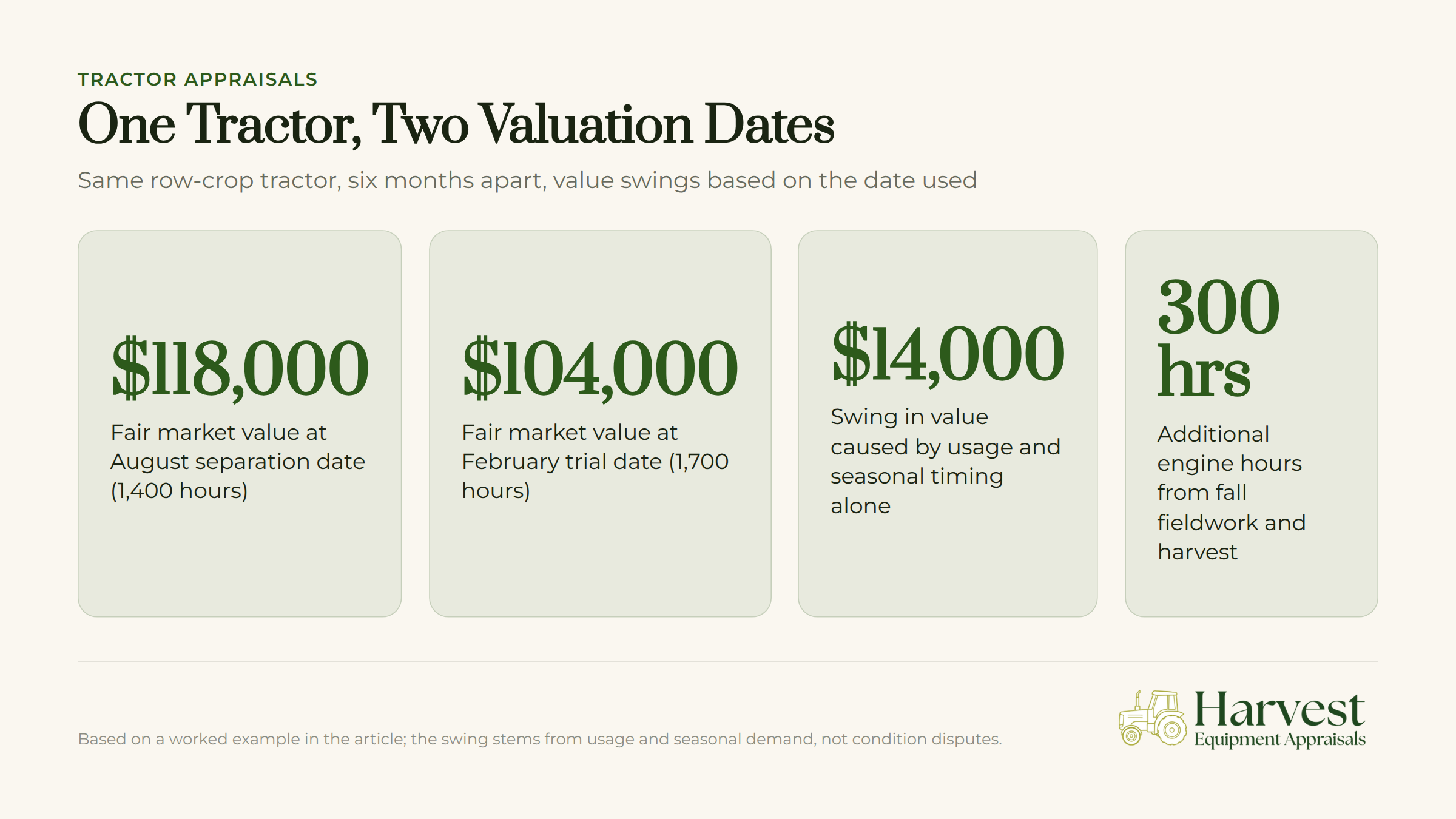
Consider a row-crop tractor with roughly 1,400 engine hours at the time of separation in August. The couple's divorce doesn't go to trial until the following February, six months later.
Between those two dates, the tractor accumulated another 300 hours of fall fieldwork and harvest use, moving it into a higher wear bracket. At the same time, the used ag equipment market softened slightly heading into winter, when buyer demand for row-crop tractors typically slows compared to the spring planting season.
- As of the August separation date: 1,400 hours, strong seasonal demand heading into harvest, appraised fair market value of $118,000.
- As of the February trial date: 1,700 hours, softer winter market, appraised fair market value of $104,000.
That's a $14,000 swing on a single asset, driven by usage and seasonal timing rather than any dispute over the tractor's condition or comparable sales data. If the state's controlling date is separation but the appraiser values the tractor as of trial (or vice versa), the number the court relies on for the division calculation is wrong before any other factor is even considered.
How a Retrospective Tractor Appraisal Works
When the controlling date falls months or years before the engagement, the appraiser is performing a retrospective appraisal: reconstructing the tractor's condition and the market as they existed on that earlier date, not as they exist today.
That means the appraiser cannot simply pull current auction results or this month's dealer listings. Instead, the work involves:
- Identifying the tractor's likely hour meter reading as of the effective date, based on maintenance records, usage patterns, or owner-reported data
- Sourcing comparable sales and listings from the period around the effective date, not the present
- Accounting for seasonal demand cycles in the ag equipment market that existed at that earlier point
- Noting any condition issues, repairs, or attachments that were present (or absent) as of that date, rather than its current configuration
This is harder than a current-date appraisal, and it requires the appraiser to document the market evidence used for that specific window of time. Our understanding of fair market value and how it diverges from a single auction result applies here too: a retrospective value has to be built from a reasoned analysis of the period's market, not backed into from one convenient data point.
What Happens When the Wrong Effective Date Is Used
USPAP, the standard our appraisers follow and published by The Appraisal Foundation, is a professional practice standard, not a rule of evidence. Following it doesn't guarantee a court will accept a report. What it does is require the appraiser to clearly identify the effective date, the type and definition of value used, and the property's relevant characteristics, so the reader knows exactly what question the appraisal is answering.
If an appraisal values a tractor as of the wrong date, a court isn't bound to simply discount the number. It can find the opinion irrelevant to the question actually in front of the judge, limit what the appraiser is permitted to testify to, or require a corrected or supplemental appraisal before the case can move forward. In a contested divorce, that kind of delay is expensive, and it can also undercut the credibility of the party who submitted it.
Watch out: A tractor's hours don't stop accumulating just because a divorce is pending. If the equipment keeps working the farm between separation and trial, hours, wear, and even attachments can change meaningfully, and a report that doesn't account for the right effective date will miss all of it.
Confirm the Date Before the Engagement Starts
The practical fix is straightforward, even if the legal question behind it isn't. Attorneys and clients should settle on the controlling valuation date, through the governing statute, a scheduling order, or a stipulation, before an appraiser is ever engaged. That date should then appear explicitly in the engagement scope and in the final report, stated separately from the inspection date and the report date.
When we scope a tractor appraisal for divorce, confirming that date is one of the first questions we ask, because it determines what market data we pull, how we document the tractor's hours and condition, and whether the assignment is a current appraisal or a retrospective one. A tractor's usage profile and depreciation curve, which we cover in more detail when we look at how hours affect tractor value, only mean something once they're tied to the correct day.
Getting the effective date right doesn't guarantee a smooth divorce, but getting it wrong is one of the most avoidable ways a valuation ends up excluded, challenged, or sent back for correction. A clear effective date, tied to the right legal standard and stated plainly in the report, gives the court exactly what it needs and nothing it has to question.
This article is provided for general informational purposes only and does not constitute legal, tax, or financial advice. Readers should consult a qualified attorney or CPA regarding their specific circumstances.