
Blog
How to Estimate the Fair Market Value of a Used Tractor
The fair market value of a used tractor is rarely the number on the dealer's sign or the auction hammer price. This guide walks through how appraisers weigh hours, condition, configuration, and regional demand to reach a number that holds up under scrutiny.
Ask three people what a used tractor is worth and you'll get three different numbers: what the dealer is asking, what it sold for at the last farm auction, and what a professional would write down in an appraisal report. Only one of those numbers is fair market value, and confusing the other two for it is the most common mistake we see when tractors change hands, get financed, or end up in an estate or divorce settlement.
This matters because fair market value is the standard the IRS Publication 561 uses for tax filings, the standard lenders lean on for collateral decisions, and the standard courts expect in a dispute. Getting it right (or hiring someone who does) is the difference between a number that survives review and one that gets challenged. Our tractor appraisal service exists for exactly this reason: to translate market noise into a documented, defensible opinion of value.
Asking Price, Auction Price, and Fair Market Value Are Three Different Numbers
Fair market value is the price a willing buyer and a willing seller would agree on, with neither side under pressure to act and both having reasonable knowledge of the relevant facts, per the IRS Publication 561 definition used across tax and appraisal contexts. Asking price and auction price are both real-world data points, but neither one is that number on its own.
An asking price is a seller's opening position. It's marked up to leave room for negotiation and reflects what the seller hopes to get, not what the market will actually bear. An auction hammer price reflects whoever happened to be in the room (or online) that day, how many bidders wanted that specific tractor, and how motivated the seller was to sell quickly rather than wait for a better offer. Neither factors in the "reasonable time to transact" condition that fair market value assumes.
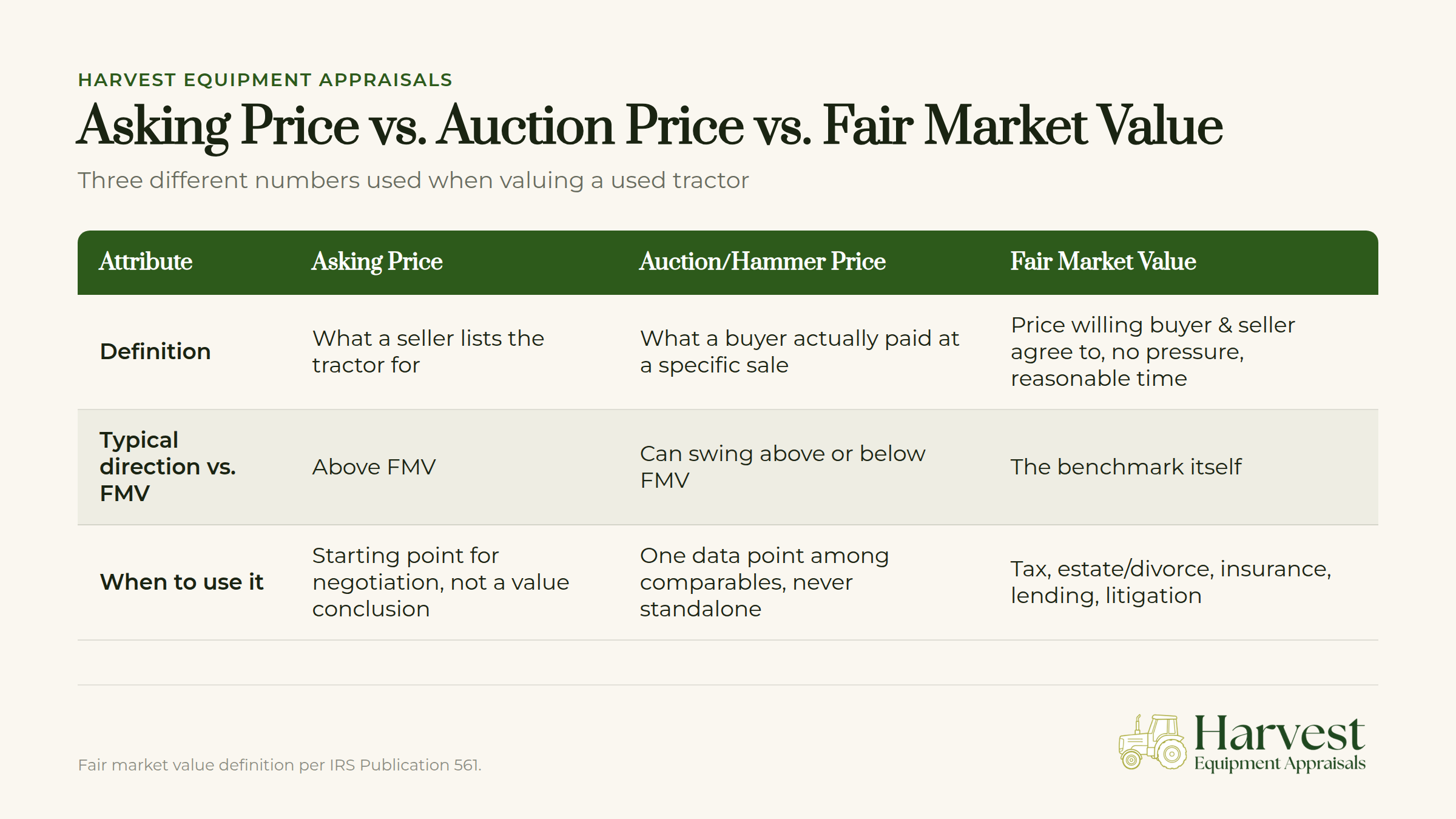
| Price Type | Definition | Typical Direction vs. FMV | When to Use It |
|---|---|---|---|
| Asking Price | What a seller lists the tractor for | Above FMV | Starting point for negotiation, not a value conclusion |
| Auction/Hammer Price | What a buyer actually paid at a specific sale event | Can swing above or below FMV | One data point among several comparables, never a standalone value |
| Fair Market Value | Price a willing buyer and willing seller would agree to, absent compulsion, with reasonable time to transact | The benchmark itself | Tax filings, estate and divorce settlements, insurance, lending, litigation |
What Fair Market Value Actually Means for a Tractor
Fair market value assumes a transaction that isn't rushed and isn't distressed. If a seller has to liquidate a tractor in 10 days because of a loan default, that sale price reflects a forced or liquidation premise, not fair market value. If a buyer has to have a specific tractor next week for planting, they'll overpay relative to FMV too.
The IRS Publication 225 farmer's tax guide applies a related concept when valuing farm items for tax purposes: market price at the nearest relevant market, in the quantities usually sold, less the direct cost of disposition. That's the same underlying logic. Value ties to a real, reasonably accessible market, not to a single outlier sale or a seller's wish list.
Watch out: A tractor's book value or depreciated cost basis on a balance sheet is not the same as its fair market value. Depreciation schedules follow tax rules, not the used equipment market, and the two numbers can diverge significantly by the time a tractor is 5 or 10 years old.
The Method Appraisers Use to Reach a Defensible Number
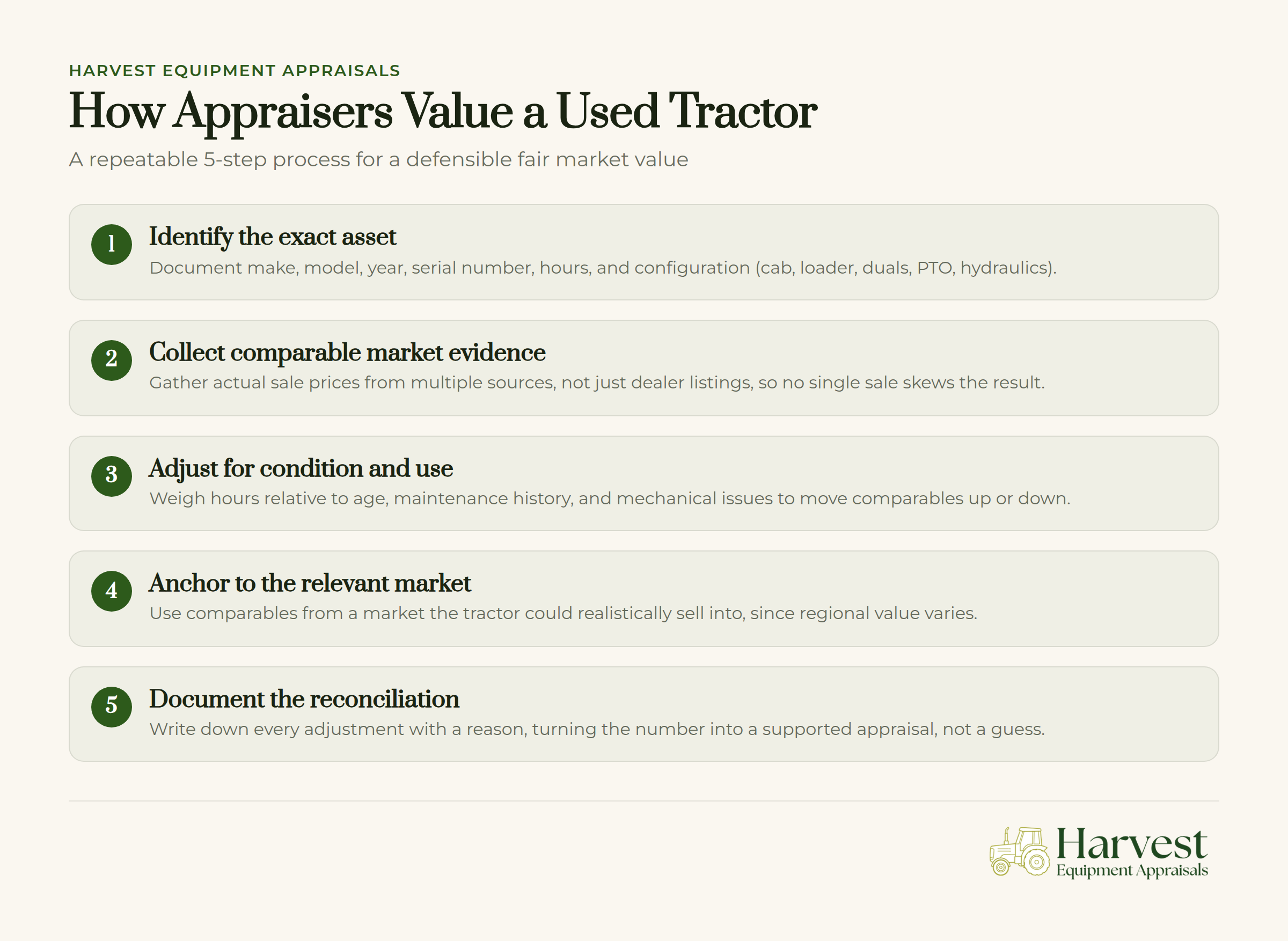
A professional opinion of value follows a repeatable process rather than a gut-check estimate. The goal is a number that's reconstructable: another appraiser, an IRS reviewer, or an opposing expert in litigation should be able to follow the same steps and land in the same range.
- Identify the exact asset. Make, model, year, serial number, hours, and configuration (cab, loader, duals, PTO, hydraulics) all get documented before any comparable search begins.
- Collect comparable market evidence. This means actual sale prices for similar used tractors, not just dealer listings, pulled from multiple sources so no single sale skews the conclusion.
- Adjust for condition and use. Hours relative to age, maintenance history, and any known mechanical issues push the comparables up or down to match the subject tractor.
- Anchor to the relevant market. A tractor's value in the Corn Belt can differ from its value in cattle country, so the appraiser uses comparables from a market the tractor could realistically sell into.
- Document the reconciliation. Every adjustment gets written down with a reason, so the final number is supported rather than asserted. This step is what separates an appraised value from an educated guess.
Factors That Move a Tractor's Fair Market Value
Once the comparables are gathered, the real work is adjusting them to match the tractor being valued. Four factors do most of the heavy lifting.
Hours of Use Relative to Age
A 10-year-old tractor with 1,800 hours has lived a very different life than a 10-year-old tractor with 6,000 hours, even if both look clean in photos. Appraisers compare a tractor's hours against age-appropriate norms for its class and use category (row crop vs. hay and livestock vs. light utility) rather than judging hours in isolation. A tractor running well below the norm for its age often commands a premium; one running well above it gets adjusted down even if it presents well cosmetically.
Mechanical Condition and Service Records
A tractor with a documented service history, including oil changes, PTO clutch work, and any major repairs, is worth more than an identical unit with no paper trail, because the buyer's risk is lower. Appraisers look past cosmetic condition to engine compression, hydraulic response, transmission shifting, and undercarriage or tire wear where applicable.
Pro tip: If you're preparing a tractor for appraisal or sale, gather maintenance receipts and any dealer service records ahead of time. A documented history is one of the few factors an owner can actively improve before a value opinion is written.
Attachments and Configuration
A front-end loader, cab with heat and air, three-point hitch implements, or dual rear wheels can add real value, but only to the extent the local buyer pool wants them. A cab tractor sells at a premium in a northern climate where operators run it in winter; the same cab adds far less value in a market where most buyers use open-station tractors for warm-weather fieldwork. Appraisers weigh attachments against what similar buyers in that market actually pay for, not against what the attachment cost new.
Regional Demand
Cropping patterns, climate, and local dealer support all shift demand for specific makes, models, and horsepower ranges. A compact utility tractor with a Kubota badge might be scarce and in high demand in one region and common as dirt in another. Brand loyalty and local dealer parts availability both factor into how quickly a tractor moves, and appraisers who understand what holds resale value in a given market build that context into the comparable selection, not just the adjustment math.
Worked Example: A 2015 Tractor With 3,200 Hours
Here's how the method plays out on a specific unit: a 2015 model-year utility tractor, 75 horsepower, cab, front-end loader, 3,200 hours, good mechanical condition with documented annual servicing, located in a Midwest row-crop and hay market.
The appraiser pulls five comparable sales from dealer inventories and recent private-party transactions in the region:
| Comparable | Hours | Configuration | Sale Price |
|---|---|---|---|
| 2014, same model | 3,600 | Cab, loader | $38,500 |
| 2015, same model | 2,900 | Cab, no loader | $37,000 |
| 2016, same model | 3,100 | Cab, loader | $41,200 |
| 2015, same model | 4,400 | Open station, loader | $34,800 |
| 2013, same model | 2,600 | Cab, loader | $39,600 |
The subject tractor's hours sit close to the average of the set, and its configuration (cab plus loader) matches the higher-value comparables. The appraiser adjusts the no-loader comparable upward for the missing loader and the open-station comparable upward for the missing cab, based on what those features add in this specific market. After reconciling the adjusted comparables and weighting them by how closely each matches the subject, the appraiser lands on a fair market value in the high $38,000s to low $39,000s range, well below the tractor's original new price and distinct from any single comparable sale on its own.
Example: If the same tractor had 5,500 hours instead of 3,200, the appraiser would shift the comparable weighting toward the higher-hour, lower-priced sale and likely conclude a value several thousand dollars lower, even though nothing else about the tractor changed.
Key takeaway: No single comparable sale, and no single asking price, tells you fair market value. It's the reconciled result of multiple adjusted comparables analyzed together.
Why a Documented, Defensible Opinion of Value Matters
A fair market value conclusion carries weight when it's built to survive scrutiny, not just when it sounds reasonable. That's what the Uniform Standards of Professional Appraisal Practice (USPAP), published by The Appraisal Foundation, exists to enforce: a documented methodology, disclosed assumptions, and a reconciled opinion of value rather than an unsupported number.
Our appraisers hold credentials with organizations such as the ASA, ISA, and CAGA and prepare every tractor valuation in accordance with USPAP, whether the report supports an estate filing, a divorce settlement, an IRS deduction, or a lending decision. If the tractor is part of a farm asset sale or trade, that value may also need to be reported on Form 4797 per USDA guidance on reporting farm asset sales, which is one more reason the underlying number needs to be right the first time.
Get a Number That Holds Up
An asking price tells you what a seller wants. An auction result tells you what happened in one room on one day. Fair market value tells you what the tractor is actually worth in a reasonably competitive market, and it's the only one of the three that stands up in a tax filing, a courtroom, or a lender's file.
If you need that number for an estate, a divorce, a donation, or a loan, request a tractor appraisal and we'll scope a fixed-fee engagement built around your tractor's specific make, model, condition, and intended use.
This article is provided for general informational purposes only and does not constitute legal, tax, or financial advice. Readers should consult a qualified attorney or CPA regarding their specific circumstances.