
Blog
Fair Market Value vs Auction Price: Why Your Tractor Won't Appraise for What It Sold For
An auction hammer price reflects one sale under one set of conditions, not the willing buyer, willing seller standard the IRS, courts, and lenders require. This guide explains why a tractor's appraised fair market value can land far from its auction result, and what a defensible appraisal has to account for.
A tractor sells at a consignment auction for $58,000. Six weeks later, an appraiser values the same machine, in the same condition, at $67,500. Nobody made an error. The auction price and the appraised fair market value are answering two different questions, and confusing them can sink a tax deduction, undermine a court filing, or stall a loan.
This matters because the IRS, family courts, and equipment lenders don't accept a single comparable sale as proof of value on its own. They require an opinion built to the fair market value standard, with the sale conditions, exposure time, and bidder pool all accounted for. Here's what separates the two, and why the gap between them is often larger than owners expect.
What Fair Market Value Actually Means for a Tractor
Fair market value is the price a tractor would bring between a willing buyer and a willing seller, with neither party under any compulsion to transact and both reasonably informed about the tractor's condition and the market it normally sells in. That definition, drawn from the standard the IRS applies to donated and estate property, is narrower and more specific than "what it sold for."
The "reasonable knowledge" piece of that standard is why a proper appraisal documents far more than a auction listing does. The IRS's own tangible personal property guidelines call for identifying the manufacturer, model, and serial number; hours of use and maintenance history; mechanical and cosmetic condition; attachments and modifications; and any functional or economic obsolescence before a value opinion is credible (Internal Revenue Manual 4.48.3). An auction result rarely comes with that documentation attached.
Fair market value also explicitly excludes a forced sale. That exclusion is baked into the federal valuation regulations that govern estate, gift, and donation appraisals: value isn't measured by what a seller received under pressure to sell quickly, in a market other than the one where that type of property is customarily sold. An auction, whatever else it is, happens on one specific day, at one specific location, among whichever bidders showed up that morning. None of that automatically satisfies "willing buyer, willing seller, no compulsion."
Key takeaway: fair market value is a standard tied to a specific date and a defined set of assumptions. An auction price is the outcome of one transaction under that auction's particular conditions. They can align, but nothing guarantees it.
Why Courts, the IRS, and Lenders Require an Independent Fair Market Value Appraisal
A judge, an IRS examiner, or a loan underwriter cares about the same thing: a value opinion that would hold up if someone challenged it. A single auction receipt doesn't do that on its own, because it can't answer whether the sale was arm's length, whether the bidder pool was representative, or whether the tractor was exposed to the market long enough to find its real price.
In a divorce proceeding where farm equipment is part of the marital estate, both sides need a value that reflects normal market exposure, not whatever a single sale happened to produce. Courts generally want an independent, USPAP-compliant opinion of fair market value rather than a comparable transaction picked by one party.
The IRS applies the same logic. A charitable donation of farm equipment valued over $5,000 requires a qualified appraisal under the substantiation rules described in IRS Publication 561, not an auction printout. Farmers allocating a lump-sum equipment purchase among multiple assets for depreciation purposes are similarly directed to divide the price based on the relative fair market value of each asset, as outlined in IRS Publication 225. Lenders operate the same way for collateral: they want a defensible number that reflects the broader market, not the result of one sale that might have been unusually thin, unusually competitive, or unusually rushed.
Orderly Liquidation Value and Forced Liquidation Value Are Not Fair Market Value
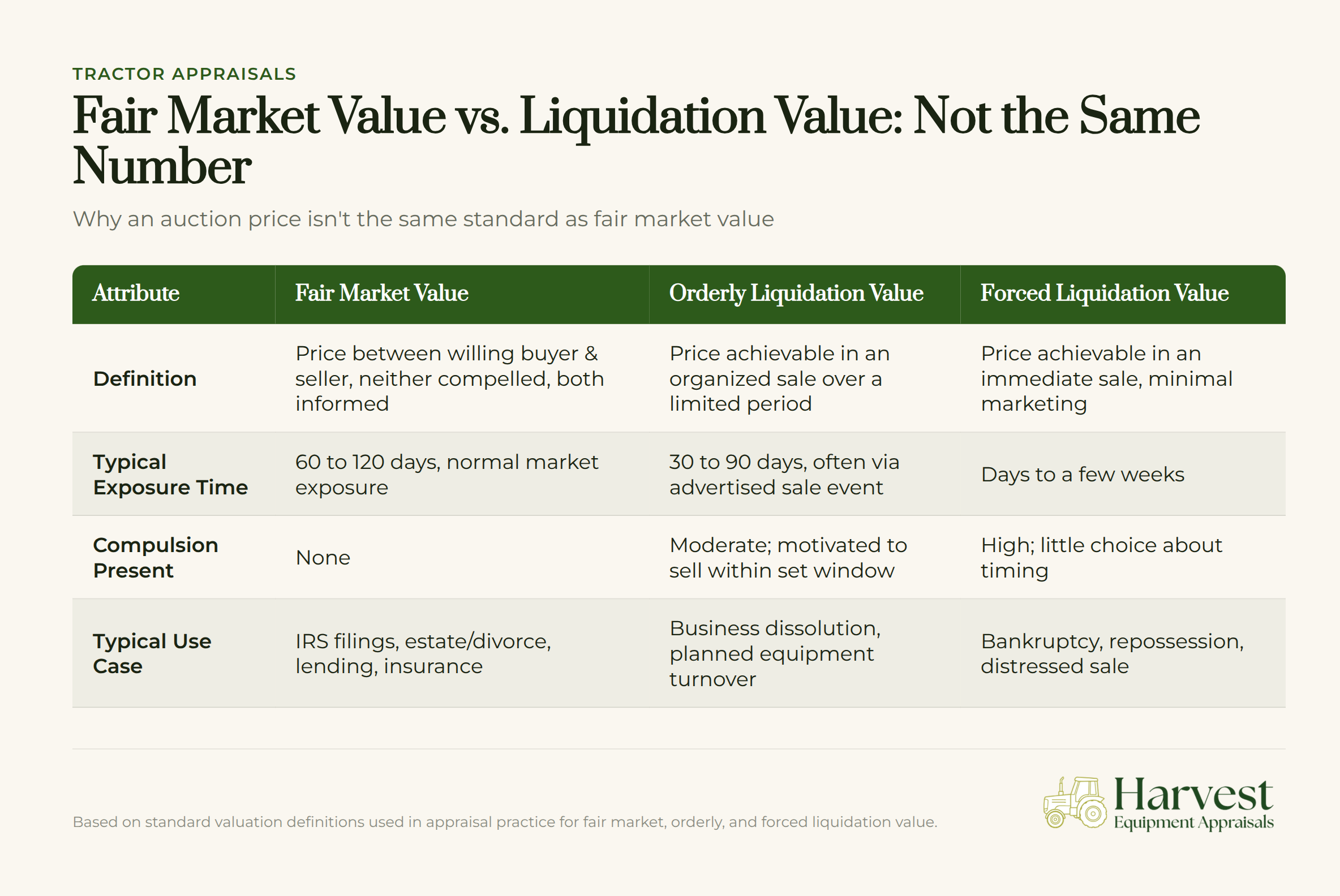
Most auction sales don't actually produce fair market value. They produce orderly liquidation value or forced liquidation value, two related but distinct standards that assume a compressed sale timeline and a seller under some degree of pressure to convert the asset to cash.
Orderly liquidation value assumes a seller has a reasonable, though limited, period to find a buyer, typically through an advertised sale process. Forced liquidation value assumes an immediate sale is required, with little to no time for normal marketing. Both differ from fair market value on the two factors that matter most: exposure time and compulsion.
| Value Standard | Definition | Typical Exposure Time | Compulsion Present | Typical Use Case |
|---|---|---|---|---|
| Fair Market Value | Price between a willing buyer and willing seller, neither compelled, both informed | 60 to 120 days, normal market exposure | None | IRS filings, estate and divorce proceedings, lending, insurance |
| Orderly Liquidation Value | Price achievable in an organized sale over a limited but reasonable period | 30 to 90 days, often via an advertised auction or sale event | Moderate; seller motivated to sell within a set window | Business dissolution, planned equipment turnover |
| Forced Liquidation Value | Price achievable in an immediate sale with minimal marketing time | Days to a few weeks | High; seller has little choice about timing | Bankruptcy, repossession, distressed sale |
A farm dispersal auction, a bank repossession sale, or a quick consignment event usually reflects orderly or forced liquidation value, not fair market value, because the seller didn't have the normal window to find the best-informed buyer. That doesn't make the auction price useless. It just means it's a different value standard, measuring a different question.
Why an Auction Result Still Needs Adjustment Before It Becomes an Appraisal
An auction result is legitimate market data. It just isn't a finished appraisal until it's adjusted for the conditions of that specific sale.
A few factors routinely cause an auction price to diverge from fair market value:
- Exposure time: A tractor listed for one auction day had far less time to reach an interested buyer than a tractor marketed for 60 to 90 days through a dealer or private treaty sale.
- Bidder pool: A local auction with 6 registered bidders reaches a narrower slice of the market than a national dealer network or an online marketplace with broader reach.
- Condition disclosure: Auction listings often lack service records, hour verification, or a documented mechanical inspection, which pushes cautious bidders to discount their offers.
- Bundling: A tractor sold as part of a larger farm dispersal lot, alongside implements or other equipment, doesn't isolate the tractor's own value.
- Buyer's premium and fees: The hammer price a seller receives is not the same number a buyer actually pays once premiums, sales tax, and hauling are added.
Regression research on tractor auction data found that hour readings materially affect price even within a narrow band of use. One study of tractors under 500 hours found that each additional hour reduced the auction price by an average of roughly $118 in the sample analyzed, a reminder that two auction results for seemingly similar tractors can differ for reasons that have nothing to do with fair market value (hedonic analysis of farm tractor auction prices). Separately, equipment valuation research notes that fair market value estimates are generally not discounted for the seller's disposal costs, such as advertising, cleaning, or brokerage, the way an auction net proceeds figure often is (Rouse Services, The Equipment Report). Comparing a hammer price to an appraised fair market value without accounting for that difference compares two numbers that were never built the same way.
Watch out: a buyer's premium of 10% to 15% means the price a buyer actually paid can run well above the hammer price reported in an auction database. If you're using auction comparables to support a value opinion, confirm whether the reported figure is the hammer price or the buyer's all-in cost.
A Worked Example: Same Tractor, Two Different Numbers
Consider a 2016 mid-size row-crop tractor, roughly 150 horsepower, with 3,400 recorded hours, sold at a farm dispersal auction.
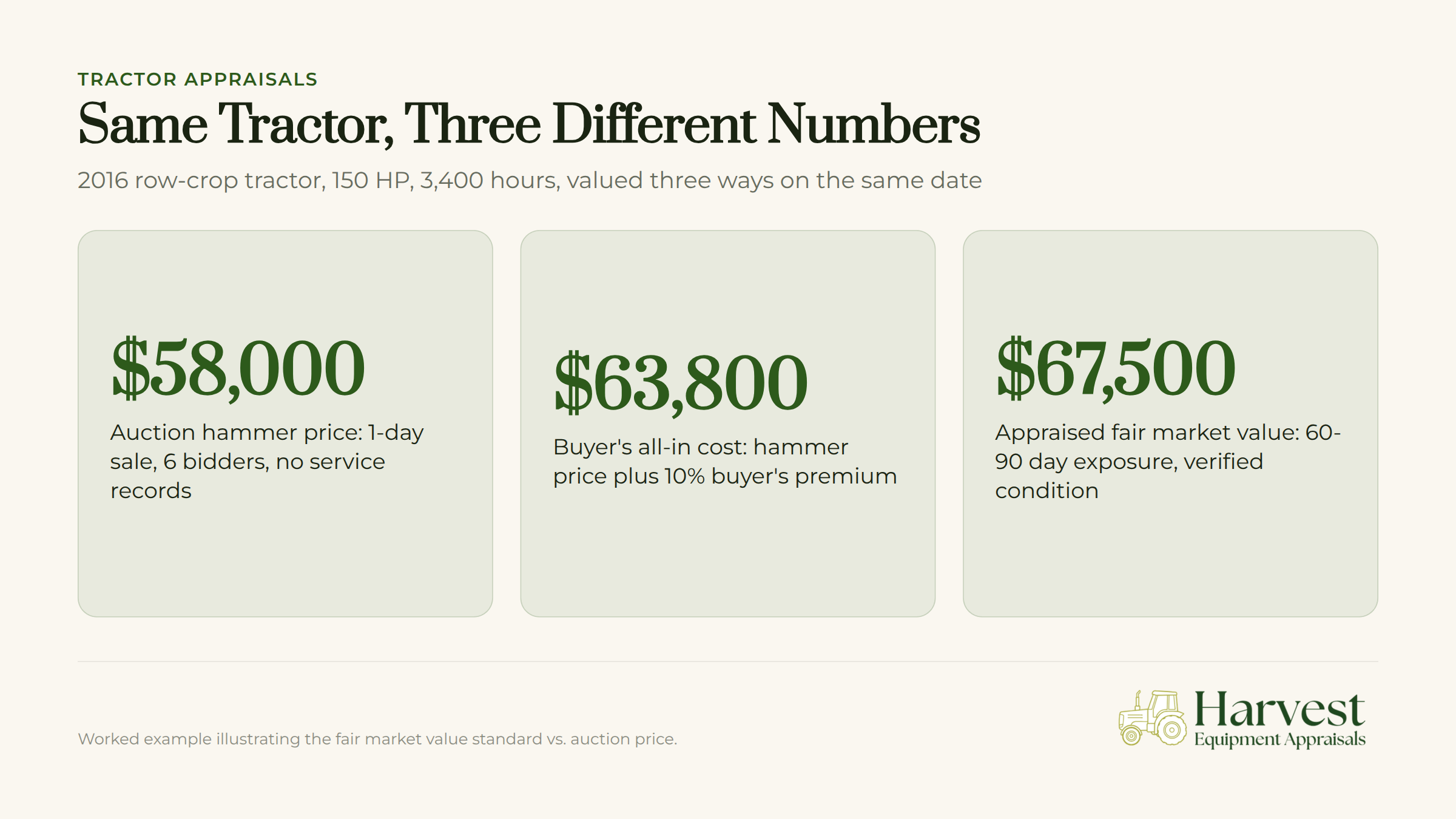
Example: The tractor hammers at $58,000. A 10% buyer's premium brings the buyer's total cost to $63,800. The sale was a single-day event with 6 registered bidders, held during spring planting when most local farmers had little time to inspect equipment, and the tractor was one of 40 lots sold that day with no service records made available before bidding closed.
An appraiser valuing the same tractor as of the same date, for an estate filing, builds the fair market value opinion differently. The appraiser reviews maintenance records, confirms the hour meter against service history, and compares the tractor against a broader set of recent sales across dealer, private-treaty, and auction channels with a normal 60 to 90 day marketing period assumed. That analysis supports an appraised fair market value of $67,500, roughly $9,500 above the hammer price and about $3,700 above the buyer's all-in auction cost.
| Figure | Amount | Basis |
|---|---|---|
| Auction hammer price | $58,000 | One-day sale, 6 bidders, no service records reviewed |
| Buyer's all-in auction cost | $63,800 | Hammer price plus 10% buyer's premium |
| Appraised fair market value | $67,500 | 60 to 90 day exposure, verified condition, broader comparable set |
Neither number is wrong. The auction figures describe what happened at one specific sale. The appraised figure describes what the tractor would most likely bring under the fair market value standard the IRS, a court, or a lender actually requires.
Don't Let a Single Sale Set Your Tractor's Value
An auction result is a data point, not a finished appraisal. Fair market value asks a more specific question than any one sale can answer on its own: what would this tractor bring between an informed buyer and an informed seller, neither one under pressure, given normal time to find the right match. Getting that number right matters most when the stakes are high, in an estate settlement, a divorce, a charitable donation, or a loan application, because that's exactly when someone else will be checking the work.
Our appraisers prepare fair market value tractor appraisals built around documented condition, verified hours, and properly adjusted comparable sales, not a single auction printout. Every engagement is quoted as a fixed fee after we scope the assignment, with standard reports starting at $195 and IRS-qualified appraisals starting at $295, never billed by the hour.
If you're weighing an auction result against what your tractor might actually be worth for tax, legal, or lending purposes, request a tractor appraisal and we'll walk you through what the report needs to cover.
This article is provided for general informational purposes only and does not constitute legal, tax, or financial advice. Readers should consult a qualified attorney or CPA regarding their specific circumstances.