
Blog
Tractor Depreciation Value: Why Hours Matter More Than Age Alone
Tractor depreciation value doesn't move in a straight line, and age alone won't tell you what a used tractor is worth. This guide covers the real front-loaded depreciation curve, why engine hours often matter more than calendar age, and a worked example comparing two same-age tractors with very different appraised values.
Most tractor owners think about depreciation the way their accountant does: a fixed percentage lost every year, spread evenly across a set number of years. That mental model works fine for a tax return. It falls apart the moment you try to figure out what a specific tractor, with its specific hours and history, is actually worth on the market today. When we prepare a tractor appraisal for an estate, a divorce settlement, a donation, or a sale, the straight-line number from the depreciation schedule is almost never the number that ends up in the report.
This matters because two tractors can be the exact same age, the exact same model, and still be worth thousands of dollars apart. The difference usually comes down to hours, condition, and how those factors show up in actual market sales, not to a formula that treats every year of ownership as identical.
Why Straight-Line Depreciation Misleads Tractor Owners
Straight-line depreciation assumes a tractor loses the same dollar amount of value every year until it hits salvage value. That assumption exists for accounting and tax convenience, not because tractors actually lose value that way.
For tax purposes, a farm tractor used in a trade or business is generally classified as farm machinery and equipment and depreciated under the Modified Accelerated Cost Recovery System, or MACRS. Many farm equipment purchases fall under a seven-year recovery period, according to Iowa State University's Center for Agricultural Law and Taxation, while the underlying class life used to define that recovery period runs closer to 10 years under published depreciation class-life tables such as the one maintained by Utah State University Extension. The IRS Farmer's Tax Guide confirms that depreciation is simply the required method of spreading a tractor's cost over its recovery period, not a measure of what the machine could sell for on a given day.
Depreciation for tax purposes begins when the tractor is placed in service and continues until its basis is fully recovered or it's retired from service, per IRS Publication 946. None of that has anything to do with hours, condition, or how the tractor was used. A fully depreciated tractor on the books can still be worth real money in the field. A partially depreciated tractor with heavy hours and deferred maintenance can be worth far less than its book value suggests.
Watch out: Book value and market value are not the same number, and using one in place of the other is one of the most common mistakes we see when owners try to estimate what their tractor is worth before requesting an appraisal. Our FAQ on estimating tractor value walks through the difference in more detail.
The Real Depreciation Curve: Steep Losses in Years 1-5, Then a Plateau
Actual tractor value loss is front-loaded, not linear. A tractor typically loses the largest share of its value in the first 5 years of ownership, then the curve flattens noticeably for the remaining life of the machine.
This pattern is consistent with how economic life is studied in agricultural engineering research: the point at which the total annual average cost of owning, operating, and repairing a machine is minimized (its economic life) tends to occur well before the machine is fully worn out, and age combined with accumulated hours is identified as the most influential factor in tracking a machine's remaining value over that curve, as documented in a technical study on optimum economic life for farm machinery.
In practical terms, the steepest depreciation happens while a tractor is still under, or just past, its first ownership cycle, when buyers pay a premium for near-new condition and low hours. Once a tractor moves into the middle of its working life, further calendar age matters less than what has actually happened to the machine during that time. A 12-year-old tractor and a 15-year-old tractor of the same model, with similar hours and condition, often carry very similar market values, while a 2-year-old and a 6-year-old of the same model can be worlds apart.
Engine Hours: The Variable That Often Matters More Than Age
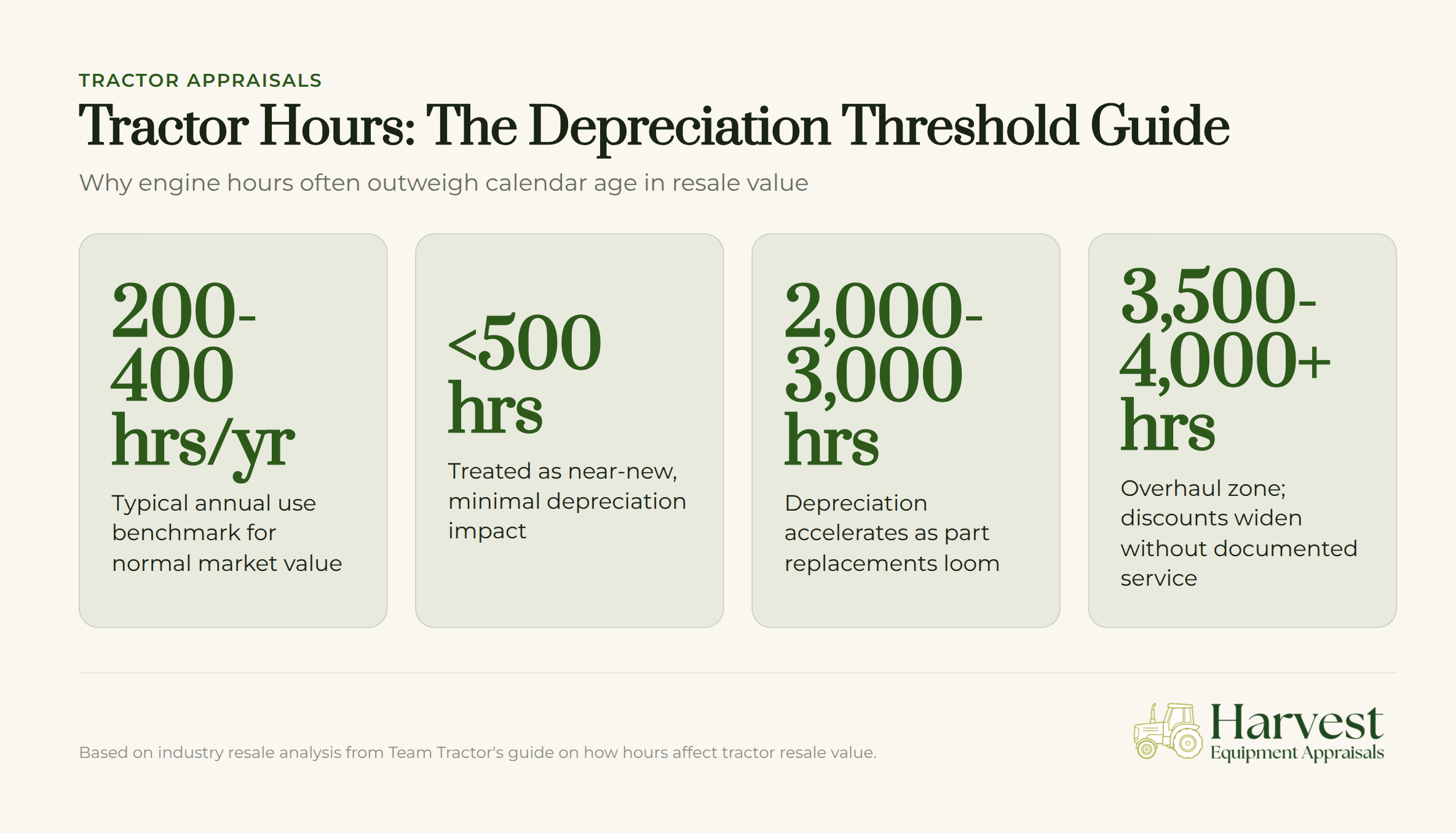
Engine hours function as an independent variable from calendar age, and in many cases they carry more weight in a tractor's value than age does. A typical tractor sees somewhere between 200 and 400 hours of annual use, depending on the operation, which gives buyers and appraisers a useful benchmark for judging whether a given machine has been worked lightly or hard for its age.
Using that benchmark, two tractors of the same age can land in very different categories:
- Low-hour for its age: A tractor running well under 200 hours per year of ownership signals light duty use, and buyers generally pay a premium because they expect more mechanical life remaining.
- Typical use for its age: A tractor tracking close to the 200-400 hour range per year sits in the normal market band for that model and vintage.
- High-hour for its age: A tractor well above 400 hours per year signals heavier use, and the market discounts it to account for greater repair risk and less remaining service life.
Industry data on resale value points to specific bands where the hour effect accelerates. Compact tractors under roughly 500 total hours are often treated as near-new, while tractors crossing into the 2,000 to 3,000 hour range see depreciation pick up pace as buyers start pricing in part replacements. Machines approaching 3,500 to 4,000 hours or more are nearing typical major overhaul territory, and discounts widen further unless there's documented overhaul work on record, a pattern described in industry resale analysis on how hours affect tractor resale value. There is no fixed dollar-per-hour deduction that applies across the board; the effect depends on tractor type, horsepower, maintenance history, and how hard the machine has actually worked.
Equipment Depreciation Schedule vs. Market Comparables: How Appraisers Reconcile the Two
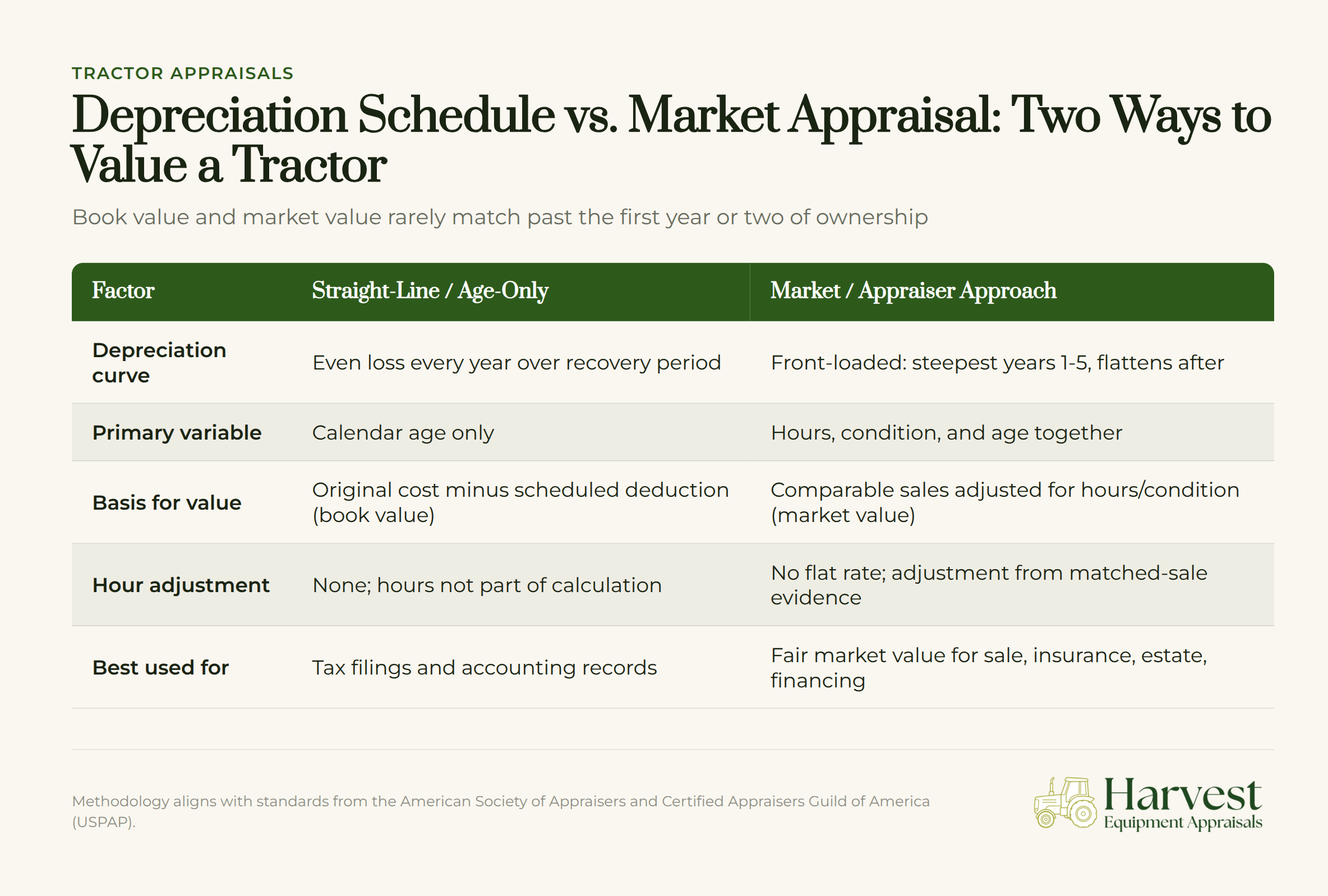
An equipment depreciation schedule tells you what a tractor is worth on paper. An appraisal tells you what it's worth in the market, and the two rarely match past the first year or two of ownership.
When we appraise a tractor, we don't start from the depreciation schedule and apply a flat per-hour deduction to it. Instead, we pull comparable sales of the same or similar model, adjust those comparables for differences in hours, condition, and configuration, and reconcile that market evidence against the cost-based depreciation curve as a secondary check. This mirrors the approach recognized across the machinery appraisal field, where credentialed appraisers holding designations such as the American Society of Appraisers or the Certified Appraisers Guild of America apply structured methodology rather than a single formula, all prepared in accordance with the Uniform Standards of Professional Appraisal Practice.
The table below shows how the two approaches diverge on the same tractor.
| Factor | Straight-Line / Age-Only Approach | Market / Appraiser Approach |
|---|---|---|
| Depreciation curve | Even loss every year over the recovery period | Front-loaded: steepest in years 1-5, flattens after |
| Primary variable | Calendar age only | Hours, condition, and age together |
| Basis for value | Original cost minus scheduled deduction (book value) | Comparable sales adjusted for hours and condition (market value) |
| Hour adjustment | None; hours are not part of the calculation | No flat rate; adjustment comes from matched-sale evidence |
| Best used for | Tax filings and accounting records | Fair market value for sale, insurance, estate, or financing decisions |
A Worked Example: Same Age, Different Hours, Different Value
Here's how this plays out on paper. Consider two 8-year-old utility tractors of the same model, both purchased new for $85,000.
Example: Using a straight-line accounting schedule with a 10-year useful life and an $8,500 salvage value, both tractors show identical annual depreciation of $7,650, landing at the same book value of $23,800 after 8 years, regardless of how either machine was actually used.
Now apply the hour data:
- Tractor A: 1,200 total hours (about 150 hours per year), well below the typical 200-400 hour annual benchmark. Recent comparable sales of similarly low-hour units of this model support an appraised fair market value around $47,500.
- Tractor B: 4,200 total hours (about 525 hours per year), well above typical annual use and approaching the overhaul range referenced earlier. Comparable sales of similarly high-hour units support an appraised fair market value closer to $34,500.
Both tractors show the identical $23,800 book value on a depreciation schedule. Their appraised market values differ by roughly $13,000, driven almost entirely by hours. That gap is exactly why a depreciation schedule and an appraisal report answer different questions, and why relying on one to answer the other's question leads owners, insurers, and courts to the wrong number.
What This Means for Your Next Tractor Appraisal
If you're trying to price a tractor for sale, settle an estate, or support an insurance claim, start with the hours and condition, not just the model year. A depreciation schedule tells you what's left of the original cost basis; it doesn't tell you what a buyer would actually pay today.
Our tractor appraisal engagements are quoted as a fixed fee after we scope the assignment, never billed hourly. Standard reports start at $195, IRS-qualified reports suitable for tax, estate, or donation purposes start at $295, and most engagements run between $195 and $495 depending on the number of units and the depth of documentation needed; unusually complex fleets or specialty configurations can run higher. You can see how age and hours are weighed together in our FAQ on what old tractors are worth as well.
When the number needs to hold up for a lender, an insurer, a court, or the IRS, a comparable-sales appraisal adjusted for hours and condition is the only approach that reflects what the tractor is actually worth. If you need that number for an upcoming transaction, filing, or dispute, you can request a tractor appraisal and we'll scope the fixed fee before any work begins.
This article is provided for general informational purposes only and does not constitute legal, tax, or financial advice. Readers should consult a qualified attorney or CPA regarding their specific circumstances.