
Blog
Itemizing a Farm Equipment Appraisal for Form 706 Estate Tax Filings
A farm equipment appraisal for Form 706 must value each tractor, combine, and implement separately as of the date of death, not lump the fleet into a single guess. This guide walks executors and estate attorneys through what Schedule F requires and how a defensible line-item schedule is built.
When a farm family settles an estate, the land usually gets the attention, but the equipment line often causes the most trouble on audit. Tractors, combines, balers, planters, and grain handling equipment all belong in the gross estate at fair market value, and the IRS expects that value itemized, dated, and supportable. This guide walks through what Form 706 actually requires for farm equipment, why a single lump-sum guess invites scrutiny, and how a proper line-item schedule gets built.
Our team prepares tractor and farm equipment appraisals for exactly this purpose, and we see the same mistake repeatedly: executors list "farm equipment, various, $400,000" and hope it holds up. It usually does not.
Why Form 706 Requires Fair Market Value as of a Specific Date
Form 706 values includible property at fair market value as of the applicable valuation date, and that date is not negotiable after the fact. Under 26 CFR 20.2031-1, fair market value is the price a willing buyer would pay a willing seller, with neither party under compulsion and both having reasonable knowledge of relevant facts. A forced-sale or liquidation price is explicitly not the standard, even though many families assume an auction result is the fallback number.
The default valuation date is the date of death. An executor may instead elect the alternate valuation date under IRC Section 2032, which shifts the measurement to six months after death, but that election applies to the estate as a whole and only when the statutory conditions are met. It is not a tool for cherry-picking a lower number on equipment alone. The IRS Form 706 instructions walk through the mechanics of that election and should guide the executor's decision together with the estate's tax counsel.
Where Farm Equipment Goes on Form 706
Farm equipment is reported on Schedule F, the personal property schedule, separate from any real estate schedules used for land and buildings. The IRS Form 706 instructions specifically identify farm machinery among the Schedule F assets, alongside farm products, growing crops, livestock, household goods, and vehicles not reported elsewhere.
That separation matters. A farm estate typically has two distinct valuation tracks running in parallel: the real property (land, grain bins, outbuildings) on its own schedule, and the movable equipment fleet on Schedule F. Mixing the two, or folding equipment value into a blended "farm" figure, makes the return harder to review and easier to challenge.
Why "Farm Equipment, Various" Won't Hold Up to IRS Scrutiny
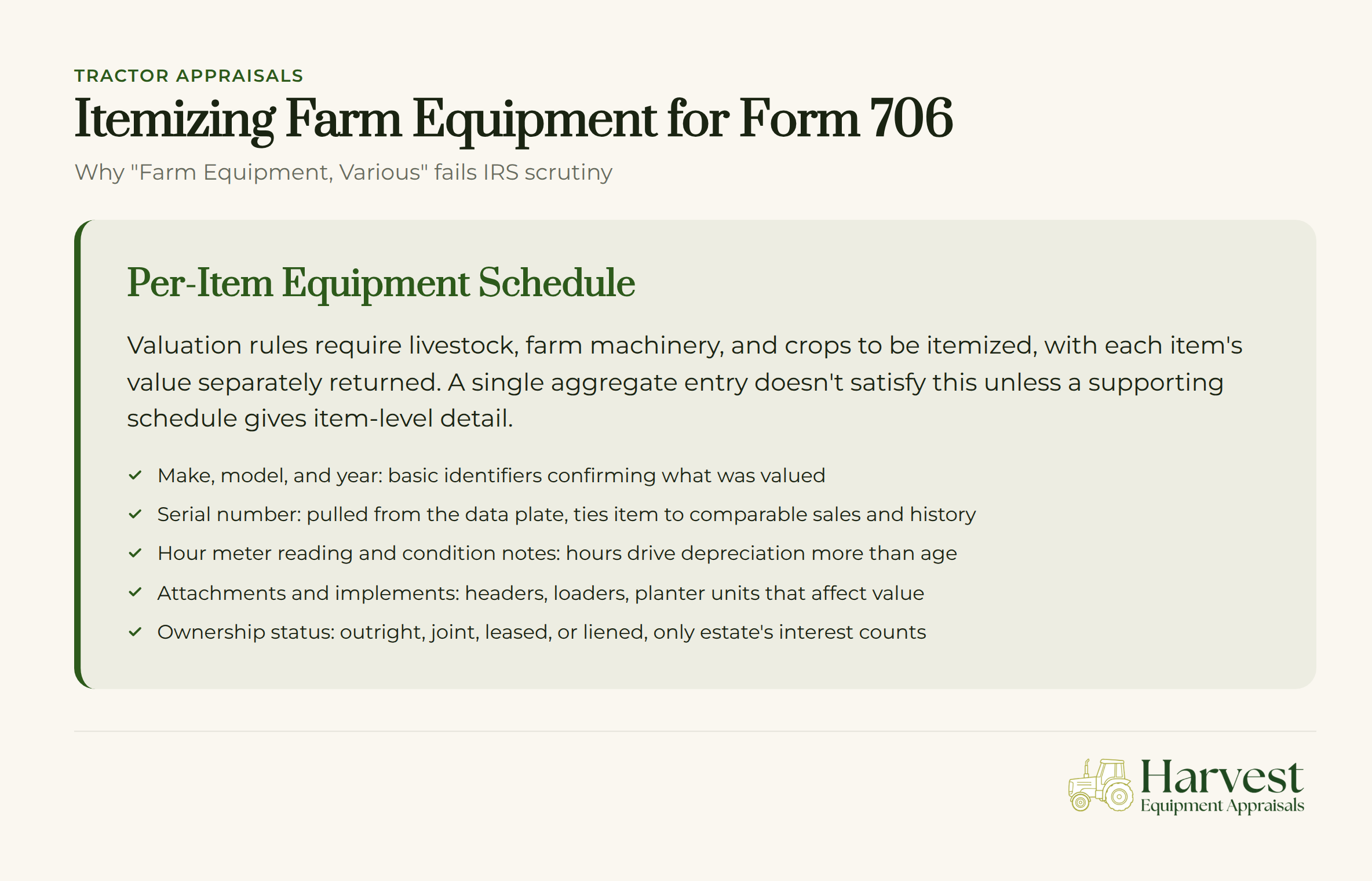
The governing valuation regulation states that livestock, farm machinery, and harvested or growing crops generally must be itemized, with the value of each item separately returned. A single aggregate entry does not satisfy that standard unless a supporting schedule supplies the item-level detail behind it.
This isn't a bureaucratic formality. A combine, a disc, and a grain cart depreciate differently, sell in different markets, and carry different condition risks. Lumping them together hides exactly the information an examiner needs to test the number, and it gives the IRS an easy opening to request a revaluation if any single figure looks off. Separate itemization also protects the estate: if one value is later challenged, the other line items stand on their own rather than dragging the whole schedule into dispute.
For each piece of equipment, the schedule should capture:
- Make, model, and year: the basic identifiers that let a reviewer, or a future appraiser, confirm what was valued.
- Serial number: pulled from the data plate, not estimated, since it ties the item to comparable sales and recall or service history.
- Hour meter reading and condition notes: hours drive depreciation on farm equipment more than age alone, and photographs of the meter at the time of inspection support the figure against later disputes.
- Attachments and implements: headers, loaders, planter units, and other add-ons that travel with the base machine and affect its value.
- Ownership status: whether the item is estate-owned outright, jointly held, leased, or subject to a lien, since only the estate's actual interest is includible.
Our guide to tractor depreciation and hour meters goes deeper into why usage, not just calendar age, drives the fair market value conclusion on a given unit.
The 2025 Filing Threshold and Where Section 2032A Fits
Form 706 is only required when the gross estate plus adjusted taxable gifts exceeds the applicable exclusion amount, which is indexed annually. For 2025, that threshold sits at $13,990,000. Because the figure adjusts each year, always confirm the current amount against the official IRS Form 706 instructions for the decedent's date of death before assuming a filing is or isn't required.
Family farms often ask about IRC Section 2032A special-use valuation in the same breath as equipment values, and it's worth drawing a clean line between the two. Section 2032A lets an estate value qualifying farm real estate based on its actual use as a farm, rather than its highest-and-best-use market value, which can meaningfully lower the land's reported value when strict statutory requirements are met. It is a real property election, not a mechanism for discounting tractors, combines, or implements. Equipment stays on Schedule F at fair market value regardless of whether the estate elects special-use valuation for the land.
The Cost of Getting the Equipment Value Wrong
Overstating and understating equipment values both carry consequences, and they cut in opposite directions.
An overstated value on Form 706 can trigger an accuracy-related penalty: a 20% addition to tax applies when the claimed value is 200% or more of the correct amount, rising to 40% if the overstatement reaches 400% or more. An appraiser who knowingly aids an understatement of tax liability through an inflated report can also face professional penalties.
Understating equipment value creates a different problem for the heirs. Property included in the gross estate generally receives a stepped-up basis equal to its reported fair market value. If the equipment is undervalued on Form 706 to reduce estate tax exposure, the heirs inherit a lower basis, and they pay more capital gains tax if they later sell that tractor or combine. A defensible, well-documented appraisal protects both sides of that equation.
How We Build a Line-Item Equipment Schedule
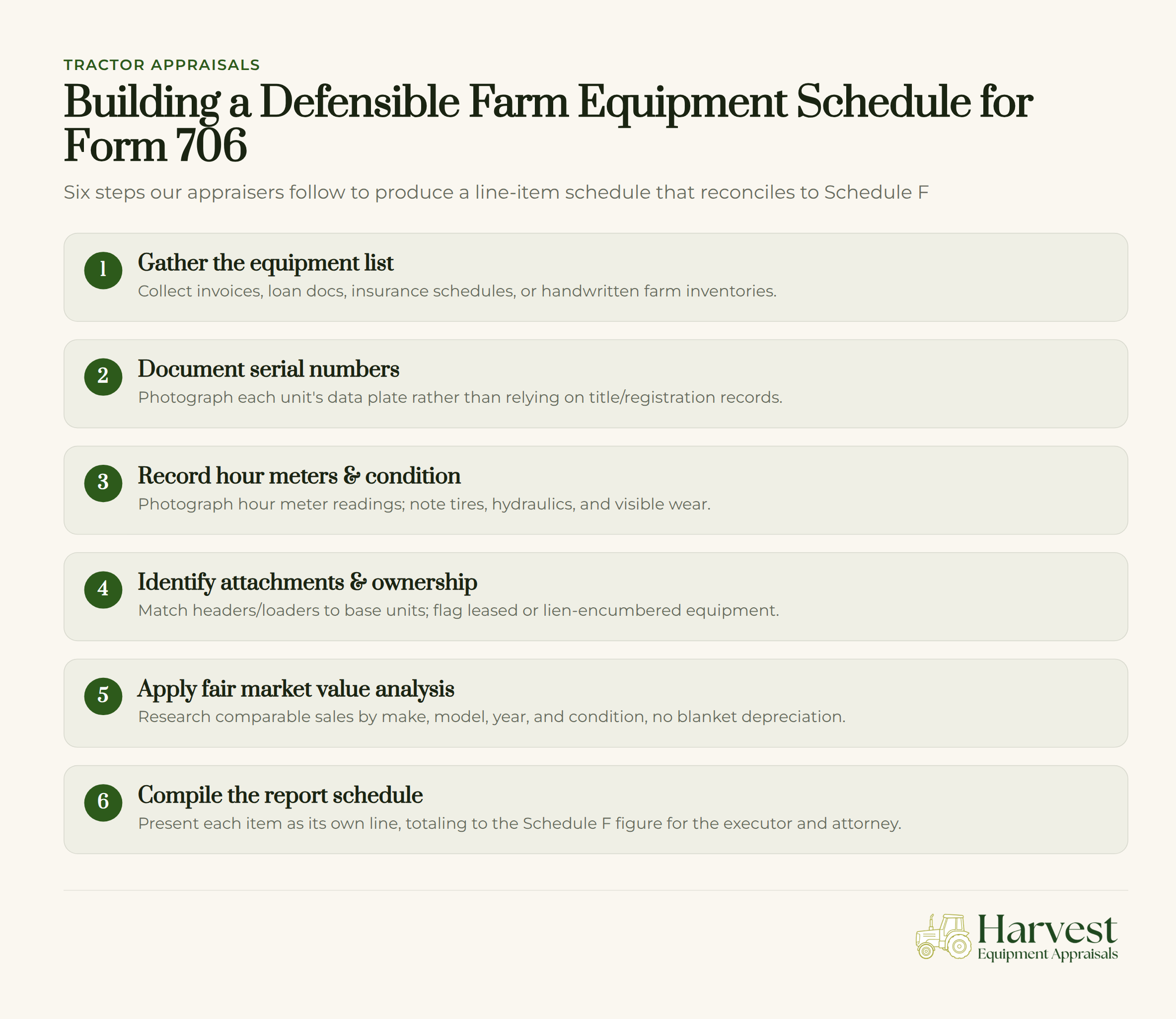
Our appraisers follow a consistent process to turn a farm's equipment fleet into a schedule that maps directly to the estate inventory and stands up to review:
- Gather the equipment list. We start with whatever records the family has: purchase invoices, loan documents, insurance schedules, or a handwritten inventory from the farm office.
- Document serial numbers from the data plate. Each unit is photographed at its identification plate, not assumed from a title or registration that may contain transcription errors.
- Record hour meter readings and condition. Photographs of the hour meter at inspection, along with notes on tires, hydraulics, and visible wear, support the condition assessment behind each value.
- Identify attachments and ownership interest. Headers, loaders, and other add-ons are matched to their base unit, and any leased or lien-encumbered equipment is flagged separately.
- Apply fair market value analysis to each item. We research comparable sales for each specific make, model, year, and condition rather than applying a blanket depreciation curve across the fleet.
- Compile the report schedule. The final report presents each item as its own line, with a total that reconciles to the figure entered on Schedule F, so the executor and the estate's attorney can map it directly to the return.
A Worked Example: Itemizing Five Pieces of Equipment
The table below illustrates the level of detail a proper Schedule F supporting schedule should carry. These figures are illustrative only and do not represent an actual appraisal conclusion.
| Item | Year/Model | Hours | Condition | Fair Market Value |
|---|---|---|---|---|
| Row crop tractor | 2017 model, 180 hp | 2,450 | Good, newer tires | $68,000 |
| Combine | 2015 model, 2WD | 1,900 (separator) | Good, header included | $145,000 |
| Planter, 16-row | 2014 model | N/A | Fair, worn seed discs | $38,000 |
| Round baler | 2018 model | N/A | Good | $22,000 |
| Grain cart, 850 bu | 2016 model | N/A | Good | $27,000 |
| Total | $300,000 |
Notice what the table does that a single "$300,000 farm equipment" entry cannot: it names each asset, dates and conditions it, and lets a reviewer trace every dollar back to a specific machine. That's the standard Treasury regulations describe for itemizing farm machinery, and it's the standard our appraisers build every farm equipment report around.
For families already working through the broader probate process, our guide to tractor appraisals for estate and probate covers how equipment valuation fits into the executor's wider responsibilities, from inventory deadlines to coordinating with the estate's attorney.
Building a Schedule That Holds Up
A farm equipment appraisal for Form 706 is really an exercise in documentation discipline: value each unit on its own, as of the correct date, with the serial numbers, hours, and condition notes to back it up. Estates that skip the itemization step aren't necessarily wrong about the total value, but they've made that value much harder to defend if it's ever questioned.
This article is provided for general informational purposes only and does not constitute legal, tax, or financial advice. Readers should consult a qualified attorney or CPA regarding their specific circumstances.