
Blog
Tractor Appraisal for Estate and Probate: A Guide for Executors
A tractor appraisal for estate purposes establishes the fair market value the probate court or the IRS requires, valued as of the date of death rather than the appraisal date. This guide walks executors through the inventory duty, the effective-date rule, and what a defensible report needs to include.
When someone who farms or ranches passes away, their tractors and attached implements become part of the estate the executor must inventory, value, and eventually distribute or sell. A tractor appraisal for estate purposes is not the same as getting a trade-in quote from a dealer. It is a formal opinion of fair market value, tied to a specific legal date, that the probate court and often the IRS will rely on. This guide covers what executors actually need to know: who requires the value, when it has to be dated, what a defensible report contains, and how the process differs from a casual online estimate.
Executors handling significant farm equipment often turn to a tractor appraisal service built specifically for USPAP-compliant valuations rather than piecing together auction listings on their own. Getting the effective date and documentation right the first time avoids delays with the court and questions from the IRS later.
Why Does an Estate Need a Tractor Appraisal?
An estate needs a tractor appraisal because both probate courts and the IRS require an accurate value of the decedent's tangible personal property before an estate can be settled. The executor uses that value to inventory the estate, pay any required court fees, distribute assets fairly among heirs, and, if the estate is large enough, complete a federal estate tax return.
Two separate obligations typically drive the need for a formal value opinion:
- Probate inventory requirements. Most probate courts require the executor to file an inventory of the decedent's property, including equipment, with a value attached to each significant asset.
- Federal estate tax filing. If the estate's gross value plus adjusted taxable gifts exceeds the federal filing threshold, the executor must file IRS Form 706, which requires supportable fair market values for every asset, tractors included.
For 2026, the federal estate tax filing threshold is $15,000,000; for a decedent who died in 2025, the threshold was $13,990,000, according to the IRS's estate tax FAQ. Many farm and ranch estates fall well under that number, but Form 706 can still be required even for smaller estates when the executor elects portability of the deceased spouse's unused exclusion.
Key takeaway: Whether or not the estate owes federal estate tax, the probate court almost always wants a documented value for tractors and other significant equipment before it will approve distribution.
What Is the Executor's Duty to Inventory Farm Equipment?
The executor (sometimes called the personal representative or administrator) has a legal duty to identify, list, and value every item of tangible personal property the decedent owned, and tractors are usually among the highest-value single items on a farm estate's inventory. This duty exists independent of whether the estate owes any tax.
In practice, that means the executor needs to catalog each tractor and its attachments individually rather than lumping "farm equipment" into a single line item. A combine, a baler, a loader attachment, and the tractor that runs them typically need separate value conclusions because condition, hours of use, and market demand differ for each piece. An executor who guesses at a round number for "all the equipment" risks both an inaccurate inventory and a challenge from co-heirs who dispute the split.
If co-heirs disagree about who inherits a particular tractor or how the equipment should be divided, an independent, USPAP-compliant appraisal gives the court and the family a neutral figure to work from rather than competing personal opinions.
What Effective Date Applies to an Estate Tractor Appraisal?
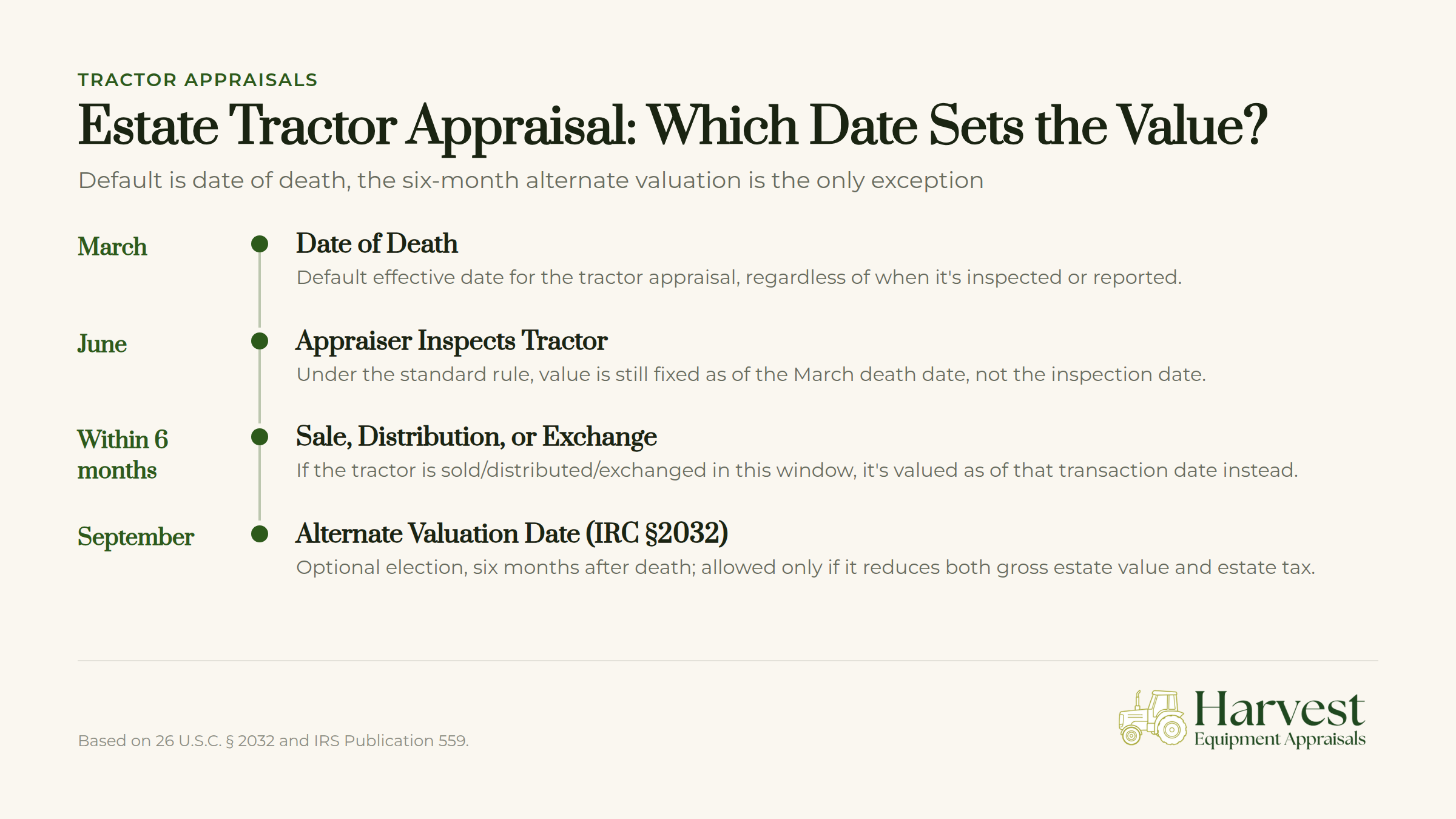
The effective date for a tractor appraisal for estate purposes is the decedent's date of death, not the date the appraiser inspects the tractor or writes the report. This is the single most important detail executors get wrong, because it is tempting to assume "current value" means the value today.
Federal law allows one exception. Under 26 U.S.C. § 2032, the executor may elect the alternate valuation date, which is six months after the date of death, but only if that election reduces both the gross estate value and the resulting estate tax. If a tractor is sold, distributed, or exchanged within that six-month window, it is valued as of the transaction date instead. IRS Publication 559 confirms that inherited property basis is generally set at date-of-death fair market value, or the alternate valuation date if properly elected.
Example: A farmer dies in March. If the executor uses the standard rule, every tractor and implement is valued as of that March date, even if the appraiser doesn't inspect the equipment until June. If the executor instead elects alternate valuation and the estate qualifies, the same tractor is valued as of the following September, unless it was sold or distributed sooner.
How Is Fair Market Value Defined for Estate Tractors?
Fair market value, for estate purposes, is the price a tractor would sell for on the open market between a willing buyer and a willing seller, neither being under compulsion to buy or sell, and both having reasonable knowledge of the relevant facts. This is the standard federal tax law applies to every asset in a decedent's estate, and it is distinct from replacement cost, original purchase price, or scrap value.
That distinction matters for tractors specifically. A ten-year-old tractor with 4,000 hours is not valued at what it would cost to buy new, nor at what the owner originally paid. It is valued at what an actual buyer in the used equipment market would pay for that exact tractor, in its actual condition, on the valuation date. IRS Publication 559 reflects this basis rule for inherited property, and it is the same standard courts expect an estate inventory to follow.
What Does a USPAP-Compliant Tractor Appraisal Report Include?
A USPAP-compliant tractor appraisal report includes a clear statement of the effective date, an itemized identification of each tractor and attachment, and the market evidence that supports the concluded value. USPAP, published by The Appraisal Foundation, is the standard framework appraisers across the country follow, and courts and the IRS both recognize reports prepared under it.
At minimum, executors should expect the report to document:
- Make, model, and serial number for each tractor, verified against the equipment itself rather than assumed from memory or old paperwork.
- Hours of use and mechanical condition, including any known repairs, wear items, or deferred maintenance that affect value.
- Comparable sales data, drawn from recent dealer listings, auction results, or private sale records for equivalent tractors.
- The effective date of value, stated explicitly as the date of death or the elected alternate valuation date.
- The intended use and intended users of the report, such as "estate tax filing" or "probate inventory," since that shapes how the value is presented.
Appraisers working in this space typically hold credentials through organizations such as the ASA, CAGA, or NEBB, and the report itself should state that it was prepared in accordance with USPAP. Reports for estate tax filing specifically need to be what's known in the industry as an IRS-qualified appraisal, which is a more rigorous standard than a general condition-and-value estimate.
Do You Need an Informal Estimate or a Qualified Appraisal?
A quick dealer walk-around or an online value estimate can be enough for a small, low-value estate where no tax filing is required and all heirs agree on the numbers. Once the estate is larger, the equipment fleet is worth real money, or any heir disputes the value, an executor needs a qualified, USPAP-compliant appraisal instead.
For an estate tax filing specifically, the IRS expects a defensible, documented opinion of value, not a rough guess. A tractor appraisal is typically quoted as a standard fixed fee from $195, or as an advanced, IRS-qualified fixed fee from $295, depending on the intended use, with typical engagements running $195 to $495 and more complex, higher-value equipment reaching $1,800 to $4,500 or more. The fee is set by the scope of the assignment (how many machines, how much documentation exists, and whether the report needs to meet IRS-qualified standards), never by the value of the tractor itself. Every engagement is quoted as a fixed fee before work begins.
How Long Does an Executor Have to File the Estate Inventory?
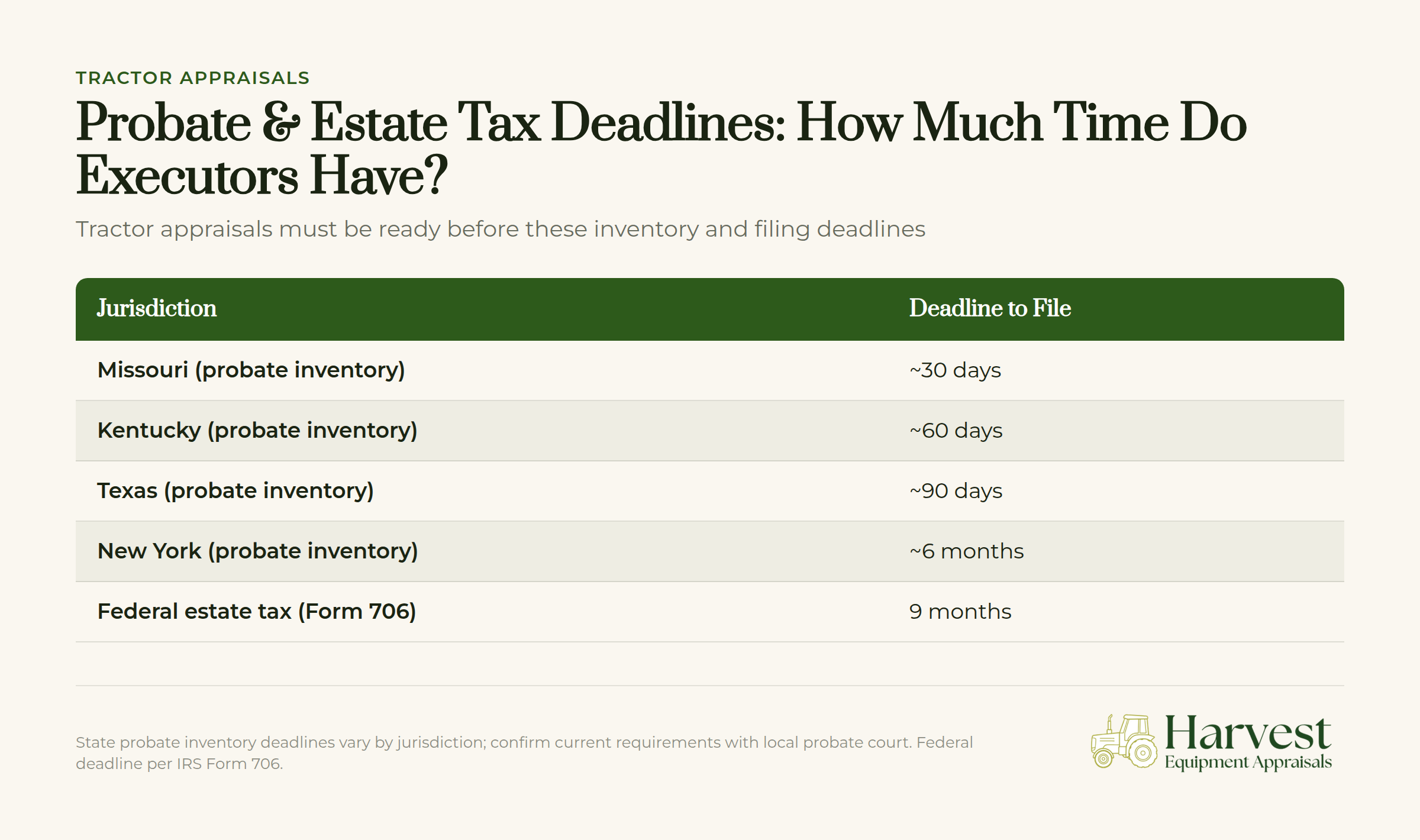
Probate inventory deadlines vary significantly by state, so executors should confirm the applicable deadline with local counsel rather than assume a national standard. As general examples, Texas typically expects an inventory within about 90 days of the executor's appointment, Missouri around 30 days, Kentucky around 60 days, and New York generally allows up to 6 months. These figures illustrate how much the timeline can shift from one state to another, and they are not a substitute for checking the specific rule in the county handling the estate.
Separately, if the estate is required to file a federal estate tax return, Form 706 is due within 9 months of the date of death, with an extension available on request. Because the tractor appraisal has to be finished before either deadline, executors are usually better served scheduling the appraisal early rather than waiting until the court or the IRS deadline is close.
Getting the Tractor Appraisal Right the First Time
An executor juggling a probate inventory, family expectations, and possibly a federal tax filing doesn't need another moving part to worry about. A tractor appraisal for estate purposes only works if the effective date, the itemized documentation, and the fair market value standard are all handled correctly from the start, since a report that gets any of those wrong can send the executor back to square one with the court.
Our team at Harvest Equipment Appraisals prepares desktop appraisals of tractors and farm equipment for estate distribution and estate tax purposes, itemizing each machine over the threshold the estate needs documented. If you're not sure how to estimate a starting figure before ordering a formal report, our guide on how to appraise a tractor and our breakdown of fair market value versus asking price are both useful starting points. When you're ready for a report the court or the IRS can rely on, request a tractor appraisal and we'll scope the assignment around your estate's specific equipment and deadline.
This article is provided for general informational purposes only and does not constitute legal, tax, or financial advice. Executors should consult a qualified attorney or CPA regarding the specific probate and estate tax rules that apply to their situation.