
Blog
Qualified Appraiser vs Dealer Quote: What the IRS Actually Requires for a Tractor Donation
A dealer trade-in quote and an IRS qualified appraisal are not interchangeable once a donated tractor's value crosses $5,000. Here's what Treasury Regulation 1.170A-17 actually requires, and why the wrong document can cost a donor the entire deduction.
Every fall, FFA chapters, 4-H programs, and land-grant ag departments receive tractors as gifts from retiring farmers and ranchers. Most donors assume a phone call to the local dealer, asking what the tractor is worth on trade, gives them enough paper to support the deduction. Once the claimed value passes $5,000, that assumption is wrong, and it is wrong in a way that can cost the donor the entire write-off, not just the difference between the dealer's number and the real one.
The IRS draws a hard line between a qualified appraisal prepared by a qualified appraiser and an informal value letter from someone trying to sell the donor a replacement machine. Our tractor appraisal service exists specifically to close that gap for donors working with agricultural nonprofits, so this piece walks through exactly what the regulation demands and why a dealer quote rarely clears the bar.
The $5,000 Threshold Is Where Everything Changes
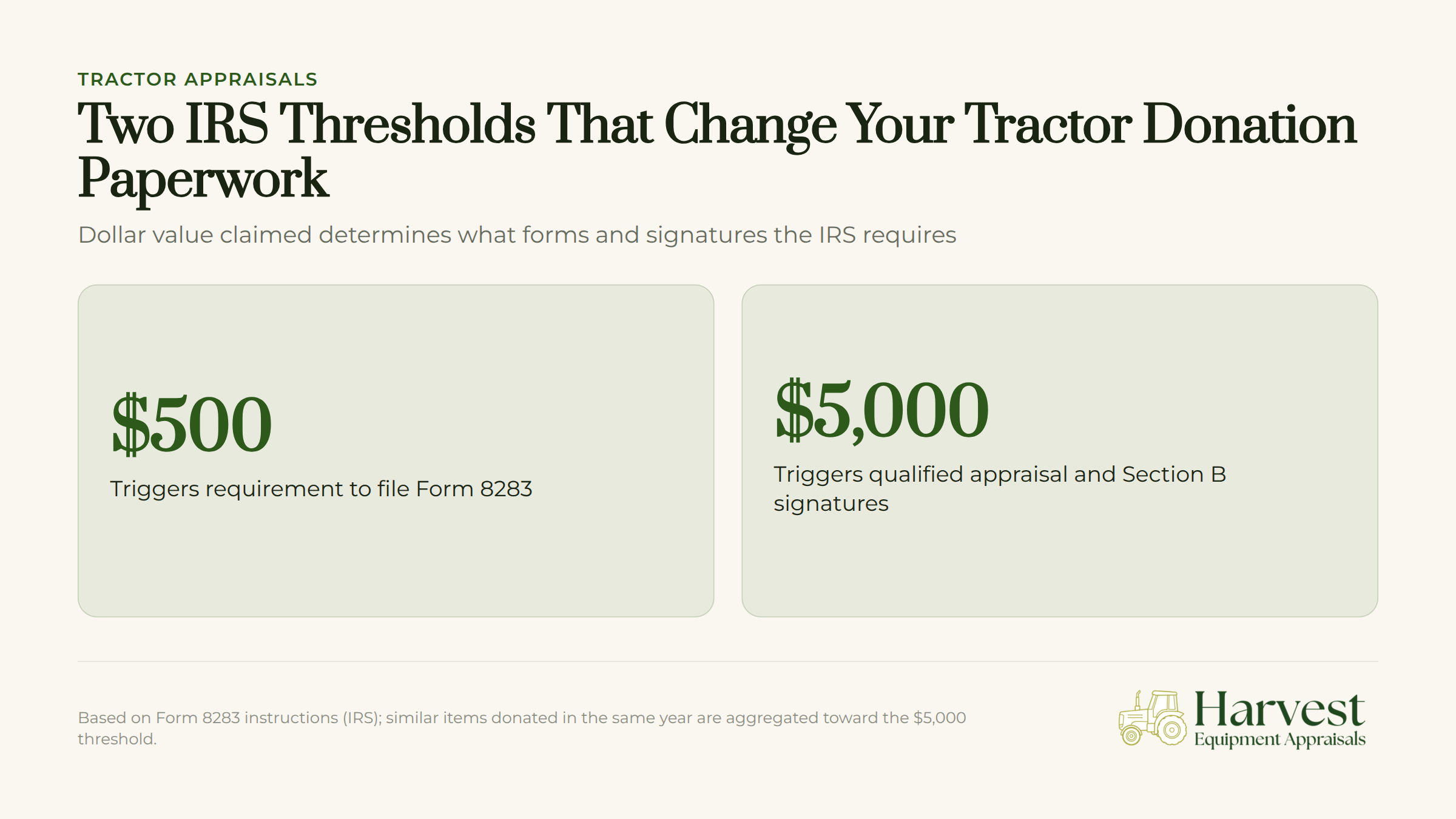
A donor who claims a deduction of $5,000 or less for a single tractor, or for a group of similar items donated in the same tax year, generally does not need a formal qualified appraisal. Once the claimed value exceeds $5,000, the rules tighten considerably.
At that point, the donor must obtain a qualified appraisal, complete Section B of Form 8283, and have the appraiser sign that section under penalty of perjury. The donee organization, the FFA chapter, 4-H program, or university ag department, also has to sign acknowledging receipt. This isn't a formality buried in the instructions; it's a structural requirement built into the statute itself, and the IRS treats Section B as the mechanism that ties a specific appraiser's credentials and opinion to a specific claimed value.
Watch out: Donors frequently believe they can round down to stay under $5,000 and skip the appraisal. The IRS aggregates similar items donated in the same year, so a tractor plus a baler plus a grain cart donated together can push the group over the threshold even if no single item does.
What Makes an Appraiser "Qualified" Under Treasury Regulation 1.170A-17
A qualified appraiser is not just anyone with farm equipment knowledge. Under 26 CFR 1.170A-17, the person preparing the appraisal must meet several specific conditions at once:
- They hold an appraisal designation from a recognized professional appraiser organization, or have completed coursework and demonstrated at least 2 years of experience valuing the specific type of property being appraised (in this case, used farm tractors and attachments).
- They regularly perform appraisals for compensation, meaning valuation work is part of their actual professional practice, not a one-time favor.
- They are not an excluded party: not the donor, not the donee organization, not the person who sold the tractor to the donor, and not someone related to or employed by any of those parties.
- They prepare and sign a written appraisal document, dated no earlier than 60 days before the date of the donation, describing the property, its condition, the valuation method used, and the specific basis for the concluded value.
Our appraisers carry credentials with organizations such as the American Society of Appraisers (ASA) and the Certified Appraisers Guild of America (CAGA), and every tractor report we prepare is built to satisfy each of these elements, not just the signature line.
Key takeaway: A qualified appraisal is a defined legal document with specific required elements, not a general description of someone's professional opinion on what a tractor is worth.
Why a Dealer Trade-In Quote Usually Doesn't Qualify
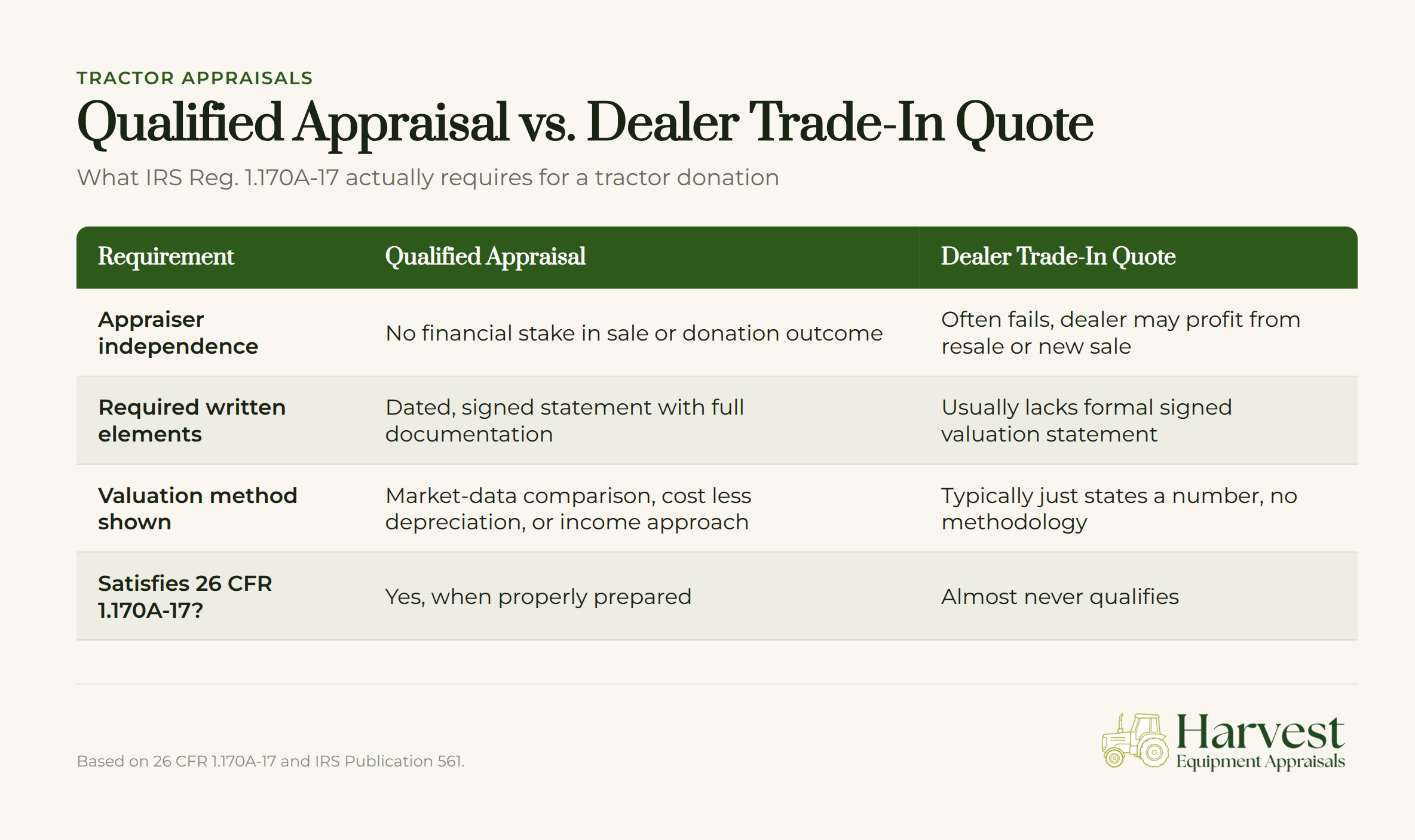
A trade-in estimate or informal value letter from an equipment dealer almost never satisfies 26 CFR 1.170A-17, for two separate reasons that both have to be cleared.
First, the document itself is usually the wrong kind of instrument. A trade-in quote is a sales estimate meant to move the dealer's next transaction forward. It typically lacks the valuation method, the comparable sales analysis, the condition narrative, and the dated, signed statement that a qualified appraisal requires. IRS Publication 561 lays out the accepted valuation approaches, market-data comparison, cost less depreciation, and in rare cases an income approach, and expects the appraiser to show their work, not just state a figure.
Second, the dealer frequently fails the independence test on its own. A dealer who stands to sell the donor a new or used machine, or who has a financial stake in the tractor's eventual resale, often falls into an excluded relationship under the regulation. Even a well-intentioned trade-in letter from a reputable dealership can be disqualified simply because the person writing it has a transactional interest in the outcome.
Example: A retiring grain farmer gets a trade-in quote of $14,000 from the dealer who sold him his new combine, then donates his old tractor to the local FFA chapter and claims $14,000 on Form 8283. On audit, the IRS can disallow the entire deduction, not because $14,000 was the wrong number, but because the dealer's letter was never a qualified appraisal and the dealer was not a qualified, independent appraiser to begin with.
An Audit Rejection Can Wipe Out the Whole Deduction, Not Just the Excess
This is the point that catches donors off guard. If the appraisal supporting a deduction over $5,000 fails to meet the qualified appraisal standard, the IRS does not simply reduce the claimed value to something more defensible. It can disallow the deduction in full, because the statutory substantiation requirement itself was never met. 26 CFR 1.170A-17 and the related Form 8283 instructions treat the qualified appraisal as a condition of the deduction, not merely supporting evidence for a number that's otherwise negotiable.
That distinction matters enormously for a donor giving a $20,000 or $30,000 tractor to an ag program. A flawed appraisal doesn't mean the donor settles for a smaller deduction after some back-and-forth with an examiner. It can mean losing the deduction entirely, after the fact, with penalties and interest layered on top.
Pro tip: If a donor has already obtained a dealer trade-in quote, it isn't wasted. It can serve as one piece of supporting market evidence inside a proper qualified appraisal, but it needs to be paired with an independent, credentialed appraiser's written report to actually satisfy the regulation.
Building a Donation File That Holds Up for FFA, 4-H, and Ag Program Gifts
A donor giving a tractor to a school ag program or a 4-H chapter should assemble a file before the return is filed, not after an audit notice arrives. For our related guide on tractor donation appraisals and the IRS deduction process, the core file generally includes:
- A written appraisal meeting the elements of 26 CFR 1.170A-17, dated within 60 days of the donation.
- Documentation that the appraiser holds relevant credentials and experience valuing farm tractors specifically, and is not the donor, the donee, or a party with a financial stake in the tractor's sale.
- A completed Form 8283, Section B, signed by both the appraiser and an authorized representative of the receiving organization, following the IRS instructions for Form 8283.
- Serial number documentation, engine hour records, photographs, and maintenance history supporting the condition and specifications cited in the appraisal.
- Comparable sales data the appraiser used to reach the concluded fair market value, consistent with the valuation guidance in IRS Publication 561.
Donors should also understand the broader distinction IRS Publication 526 draws between a straightforward noncash charitable gift and property that was used in a trade or business, since a tractor used on an active farm can carry basis and depreciation-recapture considerations that affect the deductible amount even after the appraisal itself is solid.
Our appraisers at Harvest Equipment Appraisals prepare tractor donation reports to meet these standards for donors working with agricultural nonprofits, and we quote the engagement as a fixed fee once we understand the tractor, its documentation, and the intended use of the appraisal; fees are never billed hourly and are never priced off the tractor's concluded value.
Get the Appraisal Right Before the Deduction Is at Risk
A dealer's trade-in quote can be a genuinely useful data point, but it was never built to carry the legal weight the IRS assigns to a qualified appraisal once a tractor donation crosses $5,000. The appraiser's independence, credentials, and signed Section B statement are not optional extras; they are the substantiation the deduction depends on. Donors giving equipment to an FFA chapter, a 4-H program, or a university ag department are usually giving something they're proud of, and a properly documented appraisal is what lets that generosity hold up if the return is ever reviewed.
If you're planning a tractor donation and need a report built to satisfy Form 8283 Section B and Treasury Regulation 1.170A-17, our team can scope the engagement and provide a fixed-fee quote before any work begins.
This article is provided for general informational purposes only and does not constitute legal, tax, or financial advice. Readers should consult a qualified attorney or CPA regarding their specific circumstances.