
Blog
How a Tractor Donation Appraisal Supports Your IRS Charitable Deduction
Donating a tractor to an FFA chapter or ag program can trigger the IRS $5,000 qualified appraisal requirement. Here is how the threshold, Form 8283 Section B, and the aggregation rule work together to protect your deduction.
Donating a tractor you no longer need can generate a real federal income tax deduction, but the IRS does not simply take your word for what the equipment is worth. Once the claimed value of a tractor, or a group of similar farm equipment donated in the same tax year, crosses $5,000, your deduction depends on a written qualified appraisal from a qualified appraiser and a properly completed Form 8283. This guide walks through the dollar thresholds, what counts as a qualified appraisal, how Form 8283 Section B works, and a worked example so you know exactly what paperwork to have in hand before you file. Our tractor appraisal services prepare IRS-qualified reports built for exactly this purpose.
When Does a Tractor Donation Require a Qualified Appraisal?
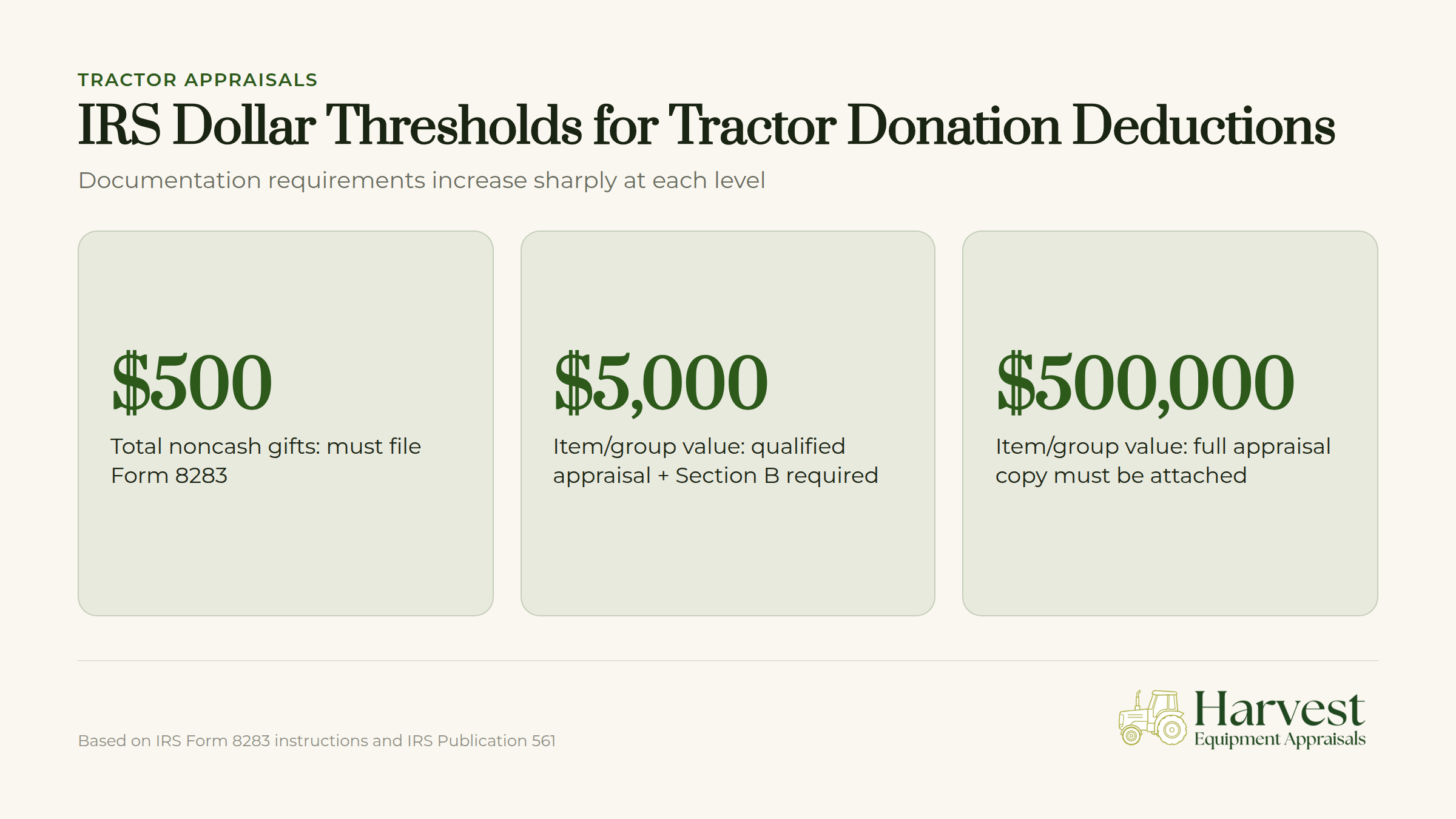
A qualified appraisal becomes mandatory once your claimed deduction for a tractor, or a group of similar farm equipment donated in the same tax year, exceeds $5,000. Below that figure, the documentation burden is lighter, but the requirements step up sharply at each threshold.
- Over $500 in total noncash gifts: You must file Form 8283 with your return once your total noncash charitable contributions for the year exceed $500, tractor donations included.
- Over $5,000 for an item or group of similar items: You need a written qualified appraisal from a qualified appraiser, and you must complete Section B of Form 8283, per the Form 8283 instructions and IRS Publication 561.
- Over $500,000 for an item or group of similar items: A complete copy of the qualified appraisal itself, not just the Form 8283 summary, must be attached to your return.
Miss the appraisal or the Section B paperwork when it is required, and the IRS can disallow the entire deduction, not just the amount above the threshold, unless the omission was due to reasonable cause rather than willful neglect.
What Is a "Qualified Appraisal" and Who Can Perform One?
A qualified appraisal is a written report, prepared for income tax purposes, that describes the donated property, states the valuation method used, and is completed no earlier than 60 days before the donation date. It must also be signed by a qualified appraiser who declares their qualifications as part of the report.
A qualified appraiser, under IRS rules, is someone with verifiable education and experience valuing the specific type of property being appraised, who regularly performs appraisals for compensation, and who is not the donor, the donee organization, or otherwise disqualified by a conflict of interest. The IRS's guidance for charitable organizations is explicit that the donee, the FFA chapter or ag program receiving your tractor, is never itself a qualified appraiser. That valuation has to come from an independent source.
For farm machinery, that independent source is typically an appraiser working under Uniform Standards of Professional Appraisal Practice (USPAP), the standard published by the Appraisal Foundation, with credentials from organizations such as the American Society of Appraisers, the Certified Appraisers Guild of America, or NEBB's machinery and equipment program. Our team follows the same comparable-sales and depreciation-based methodology described in our guide to estimating a used tractor's fair market value, adapted here for a charitable-donation opinion rather than a resale estimate.
Watch out: A donation receipt from the charity is not a substitute for a qualified appraisal once you are above $5,000. The receipt confirms the gift happened; the appraisal establishes what it was worth.
How Does IRS Form 8283 Section B Work?
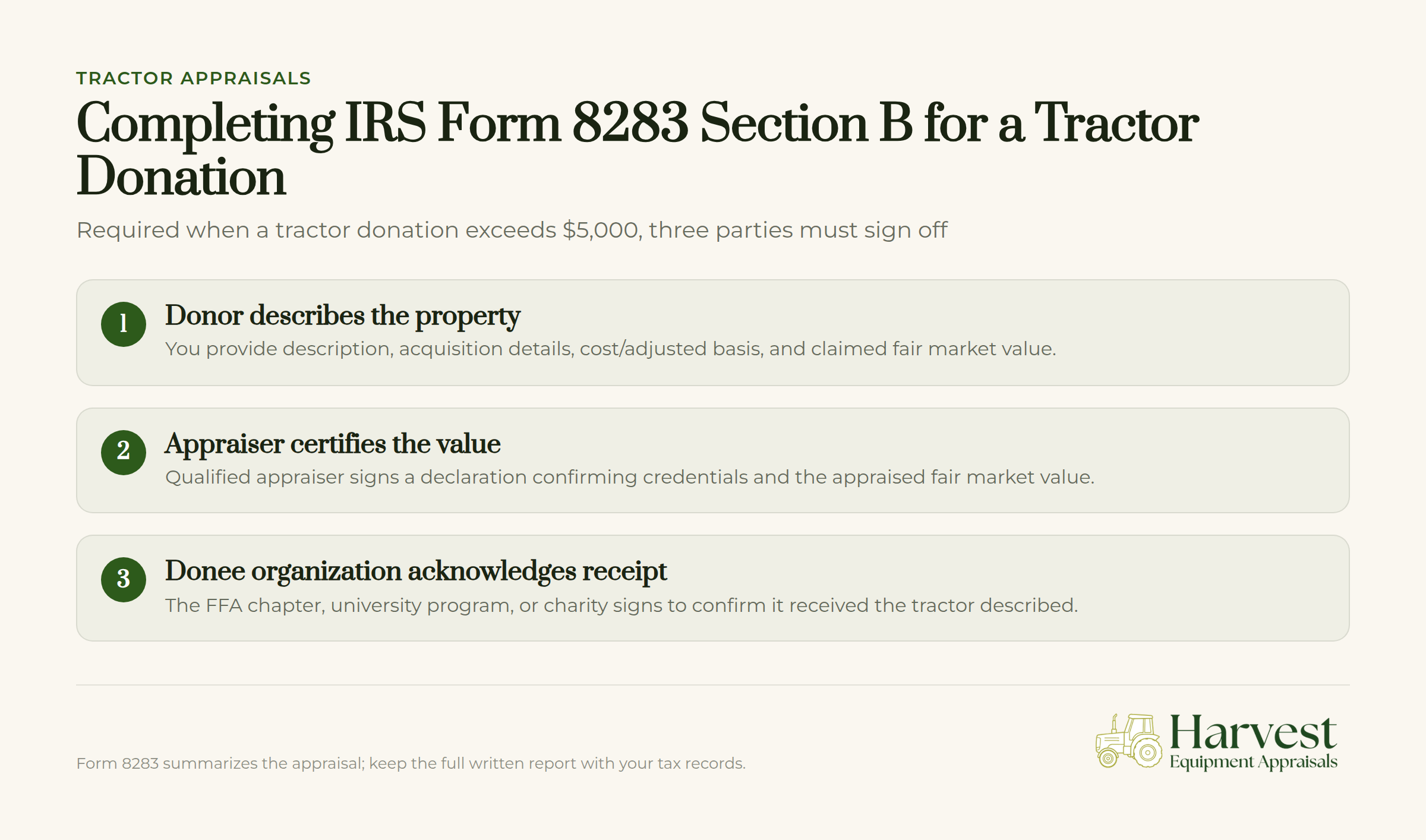
Section A of Form 8283 covers smaller noncash donations, generally under $5,000, and asks for basic descriptive information you can complete yourself. Section B is the section that applies once your tractor donation (alone or combined with similar items) exceeds $5,000, and it requires input from three different parties.
- You describe the property. As the donor, you provide a description of the tractor, how and when you acquired it, your cost or adjusted basis, and the fair market value you are claiming.
- The qualified appraiser certifies the value. Your appraiser signs a declaration confirming their qualifications and the appraised fair market value, as required under the Form 8283 instructions.
- The donee organization acknowledges receipt. The FFA chapter, land-grant university program, or other charity signs to confirm it received the tractor described in the appraisal.
Form 8283 itself is only a summary of the appraisal. It is not a substitute for the underlying written report, which you should keep with your tax records even in years when you are not required to attach it.
When Must You Receive the Appraisal? (Timing Rule)
The appraisal has to be dated no earlier than 60 days before you actually transfer the tractor to the charity, and you must receive it no later than the due date, including extensions, of the tax return on which you first claim the deduction. If you claim the deduction on an amended return instead, the appraisal must be in hand before you file that amended return.
This timing window matters more than it looks. An appraisal dated too far in advance of the donation, or one obtained after you have already filed, does not qualify, even if the dollar figure it produces is accurate. IRS Publication 561 treats an appraisal that falls outside this window the same as having no appraisal at all.
The Aggregation Rule: Multiple Pieces of Equipment Count Together
Here is where a lot of donors get caught off guard. The IRS does not look at each item in isolation when deciding whether the $5,000 threshold applies. It groups "similar items" of donated property together and applies the threshold to the combined total.
Example: A farmer donates a used tractor valued at $4,200 to a land-grant university ag program in March, then donates a hay baler valued at $1,100 to the same program in October. Neither item alone crosses $5,000, but together they total $5,300. Because both are farm equipment donated in the same tax year, the IRS treats them as a group of similar items, and the farmer now needs a qualified appraisal and a completed Section B for the combined donation.
The same grouping applies even if the items go to different charities. If you donate a tractor to one FFA chapter and a separate piece of farm machinery to another organization in the same year, both count toward the same $5,000 and $500,000 thresholds because they are similar items of property.
Worked Example: Donating an Older Tractor to an FFA Chapter
Consider a farmer retiring an older diesel tractor and donating it to a local FFA chapter's mechanics program instead of trading it in.
| Detail | Figure |
|---|---|
| Original purchase price (used, 12 years ago) | $28,000 |
| Adjusted basis after depreciation | $6,800 |
| Comparable auction and dealer sales for similar age, hours, and condition | $6,200 to $6,900 |
| Appraised fair market value | $6,500 |
Does the threshold apply? Yes. At $6,500, the claimed deduction exceeds $5,000, so the farmer needs a qualified appraisal and must complete Section B of Form 8283, not Section A.
What the appraiser documents. A qualified appraiser working under USPAP would describe the tractor's make, model, year, hours, and condition, then support the $6,500 conclusion using comparable sales of similar tractors, consistent with the fair market value methodology described in IRS Publication 561.
What happens at tax time. The farmer completes Part I of Section B describing the tractor and the claimed value, the appraiser signs the declaration in the appraiser section, and the FFA chapter signs to acknowledge receiving the equipment. The farmer keeps the full written appraisal with tax records even though, at $6,500, the return does not require attaching the complete report (that requirement only kicks in above $500,000).
The lesson. A modest tractor donation can easily land in Section B territory once you account for actual fair market value rather than a rough guess, and the paperwork chain (donor, appraiser, donee) has to be complete before the return is filed.
Why a USPAP-Compliant Appraisal Strengthens Your Deduction
A properly documented appraisal does more than satisfy a filing requirement. It gives you a defensible, third-party opinion of value if the IRS ever asks questions about a noncash deduction, and it protects the charity receiving the equipment from being drawn into a valuation dispute it had no part in creating.
Our tractor appraisals prepared for IRS purposes start at $295, with typical engagements for a single unit running $195 to $495 depending on the equipment's age, documentation available, and the depth of comparable-sales research required. Every engagement is quoted as a fixed fee before we begin, never billed hourly, and the fee itself is not deductible as part of your charitable contribution.
Key takeaway: the appraisal fee reflects the scope of the assignment, not the value of the tractor being appraised. A well-documented $6,500 tractor and a well-documented $60,000 combine harvester take different amounts of research, and that is what the fee is based on, not the number that ends up on your return.
If you are planning a farm equipment donation this year and expect the value to land anywhere near $5,000, it is worth requesting a tractor appraisal before you transfer the equipment rather than after. Getting the timing and the documentation right the first time is far simpler than trying to reconstruct it once the filing deadline is close.
This article is provided for general informational purposes only and does not constitute legal, tax, or financial advice. Readers should consult a qualified attorney or CPA regarding their specific circumstances.