
Blog
What Makes a Tractor Appraisal USPAP-Compliant for Legal and Tax Use
A USPAP-compliant tractor appraisal follows specific personal property standards for scope of work, valuation approach, and reporting that a casual value estimate skips entirely. This guide explains what those standards require and exactly when the IRS, courts, and lenders make USPAP compliance mandatory.
A tractor appraisal and a USPAP-compliant tractor appraisal are not the same document. Anyone can look up a make and model and quote a number. A USPAP-compliant appraisal is a formal opinion of value developed and reported under the personal property standards that apply to machinery and equipment, and it holds up when the IRS, a court, or a lender reviews it. If you need a number for an estate filing, charitable deduction, or divorce settlement, the distinction determines whether your appraisal actually does its job.
This matters most in a handful of recurring situations: an estate and probate filing that requires date-of-death fair market value, a charitable donation deduction claimed on IRS Form 8283, a farm loan collateral review, or litigation where opposing counsel will look for any gap in the appraiser's methodology. In each case, the report has to survive scrutiny from someone whose job is to find a reason to reject it.
Who Publishes USPAP and Why It Applies to Tractors
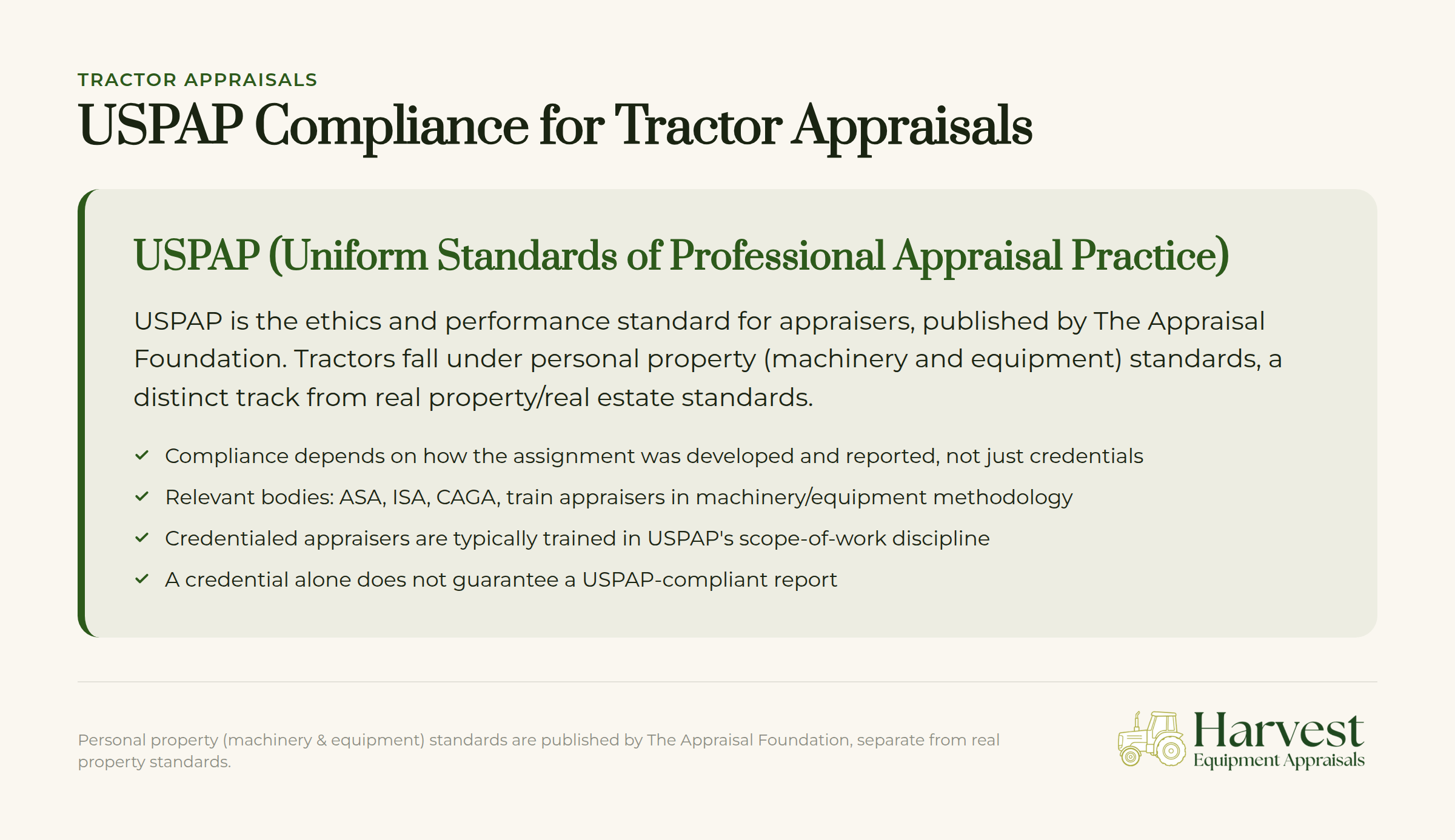
USPAP stands for the Uniform Standards of Professional Appraisal Practice. It's published and updated on a regular cycle by The Appraisal Foundation, and it covers every appraisal discipline, not just real estate. Personal property, which USPAP defines to include machinery and equipment, falls under its own set of development and reporting standards, separate from the ones written for houses and land.
A tractor is personal property in appraisal terms. It's a tangible, movable asset, and it gets valued under the personal property standards rather than the real property standards most people associate with the word "appraisal." That distinction is why a real estate appraiser's license doesn't qualify someone to appraise a tractor, and why a generic online valuation tool doesn't produce a USPAP-compliant report no matter how accurate the number turns out to be.
Credentials That Matter for Equipment and Farm Machinery Appraisers
Credentials signal that an appraiser has trained specifically in machinery and equipment valuation, not just personal property in general. The organizations most relevant to tractors and farm equipment include the American Society of Appraisers (ASA), the International Society of Appraisers (ISA), and the Certified Appraisers Guild of America (CAGA), each of which trains and certifies appraisers in machinery and equipment methodology.
Holding a credential from one of these organizations doesn't automatically make a report USPAP-compliant. Compliance is a function of how the assignment was developed and reported, not just who signed it. But an appraiser working toward or holding one of these credentials has typically been trained in exactly the scope-of-work and reporting discipline USPAP requires, which is why credentials and compliance tend to travel together in practice.
What a USPAP-Compliant Tractor Appraisal Report Must Include
A compliant report has to give the client and any intended user enough information to understand how the appraiser reached the value, not just what the value is. That standard shows up in several concrete report elements:
- Identification of the property and the problem to be solved: the specific tractor (make, model, year, serial number, hours, condition) and the exact question the appraisal is answering, such as "fair market value as of the date of death."
- A defined scope of work: what research, inspection, and data verification the appraiser actually performed, and why that scope was sufficient to produce a credible result for the intended use.
- Consideration of all three valuation approaches: the cost approach, the sales comparison approach, and the income approach must each be considered, even when only one or two are ultimately used to reach the final conclusion of value.
- Disclosure of assumptions and limiting conditions: anything the appraiser assumed to be true without independent verification, along with any conditions that limit how the report can be used.
- A signed certification: the appraiser's statement that the assignment was completed impartially and in accordance with USPAP, along with disclosure of any significant help received from another appraiser, engineer, or equipment specialist.
Miss any of these and the report stops being a USPAP-compliant appraisal and becomes a value opinion with no standard behind it. That gap is exactly where an IRS reviewer, an opposing attorney, or an underwriter will push back.
When Does USPAP Compliance Become Mandatory?
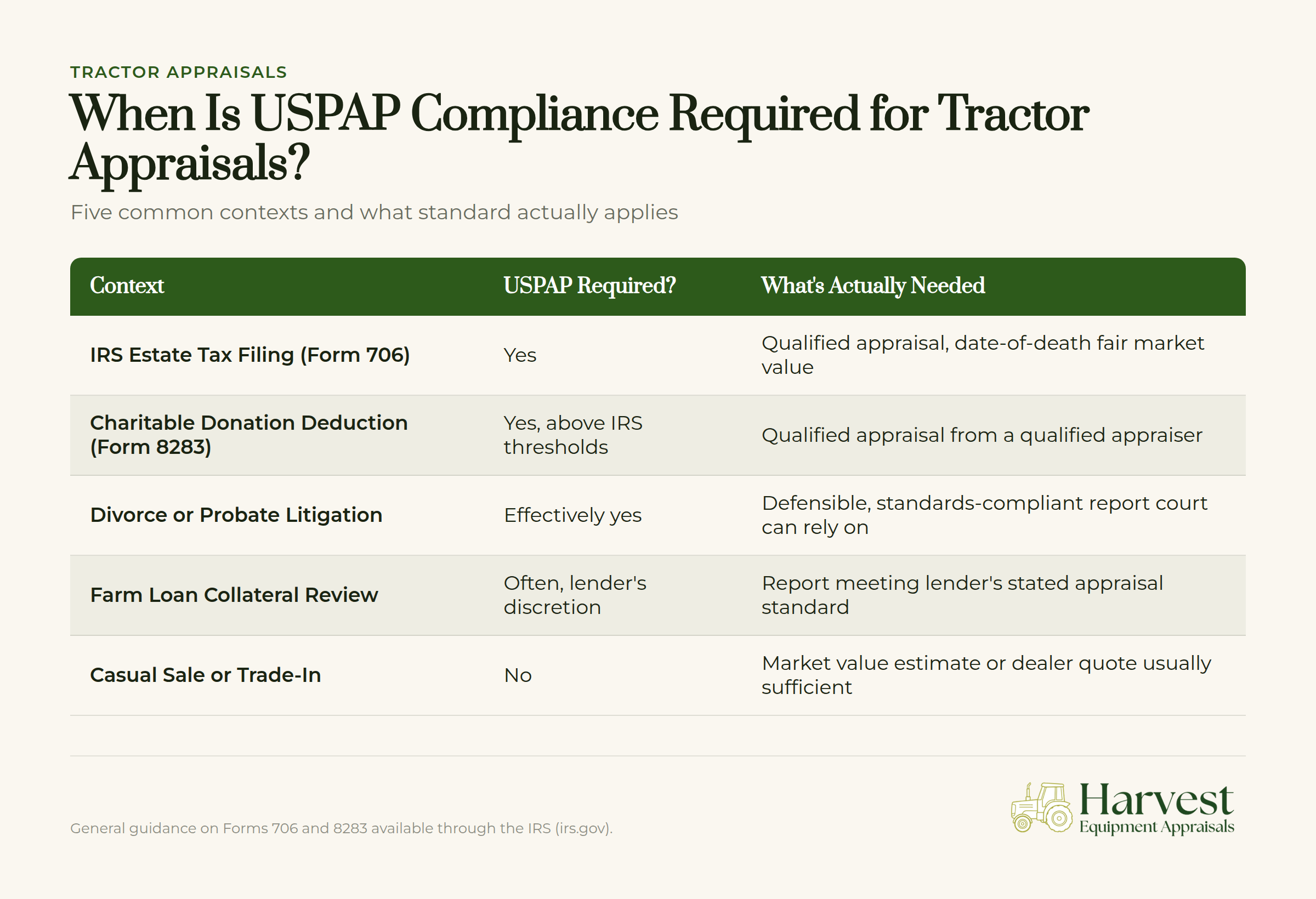
USPAP compliance is required whenever a governing body, a statute, or a client's stated requirement calls for it. It is not automatically required for every tractor value question, but it becomes mandatory the moment the appraisal feeds into an IRS filing, a court proceeding, or a regulated loan decision.
The IRS requires appraisals filed with estate tax returns (Form 706) and charitable donation deductions (Form 8283) to meet current industry appraisal standards, and USPAP is the standard cited across the appraisal profession for that purpose. General guidance on both forms is available through the IRS. Farm lenders reviewing tractors as loan collateral, and courts handling divorce or probate disputes, generally expect the same standard because it is the one most likely to withstand challenge.
| Context | Is USPAP compliance required? | What's actually needed |
|---|---|---|
| IRS estate tax filing (Form 706) | Yes | Qualified appraisal, date-of-death fair market value |
| Charitable donation deduction (Form 8283) | Yes, above IRS reporting thresholds | Qualified appraisal from a qualified appraiser |
| Divorce or probate litigation | Effectively yes | Defensible, standards-compliant report the court can rely on |
| Farm loan collateral review | Often, at lender's discretion | Report meeting the lender's stated appraisal standard |
| Casual sale or trade-in negotiation | No | A market value estimate or dealer quote is usually sufficient |
Getting a Defensible Number, Not Just a Number
The test for a USPAP-compliant tractor appraisal isn't whether the value sounds reasonable. It's whether the report shows its work well enough that an IRS examiner, a judge, or a lender's underwriter can follow the reasoning and accept the conclusion. That means the right personal property standards, a credentialed appraiser, a clearly stated scope of work, and a report that discloses its assumptions instead of hiding them.
If you're preparing a tractor appraisal for an estate, a donation, a divorce, or a loan, start with the intended use and work backward from there. Our appraisers build every tractor appraisal around the standard the assignment actually requires, whether that's an IRS-qualified report or a straightforward market value opinion, so the number you receive holds up under the scrutiny it was written for.
This article is provided for general informational purposes only and does not constitute legal, tax, or financial advice. Readers should consult a qualified attorney or CPA regarding their specific circumstances.